Bottom Line
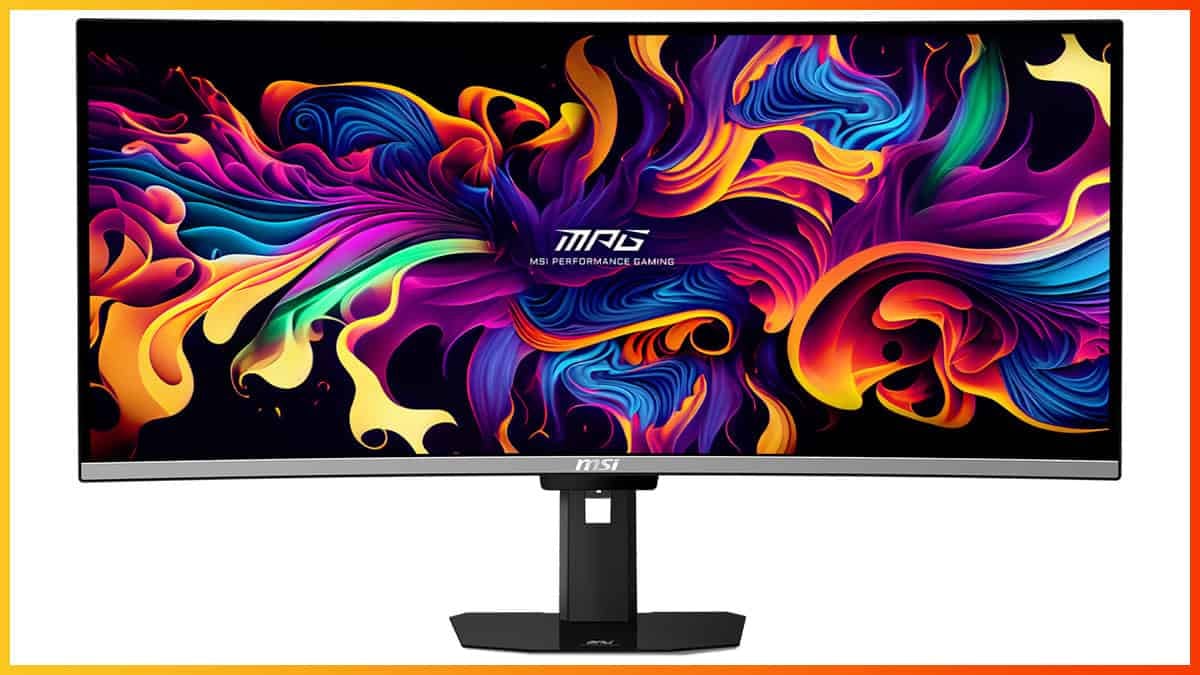
The MSI MPG 341CQR QD-OLED X36 offers the highest brightness, sharpest text, and most effective reflection handling of any QD-OLED panel so far!
Update
Initial review published on January 4, 2026. MSI supplied us with a new v.014 firmware update for our early sample with the following improvements:
- Corrected the EOTF Boost brightness table issue that caused picture quality inconsistency compared with other HDR curves.
- Fixed abnormal Power LED flickering during the Panel Protect process.
- Resolved an AI Brightness mapping customization error.
- Fixed multi-language display issues.
- Updated the Custom (True Black 500) function, which is now adjustable.
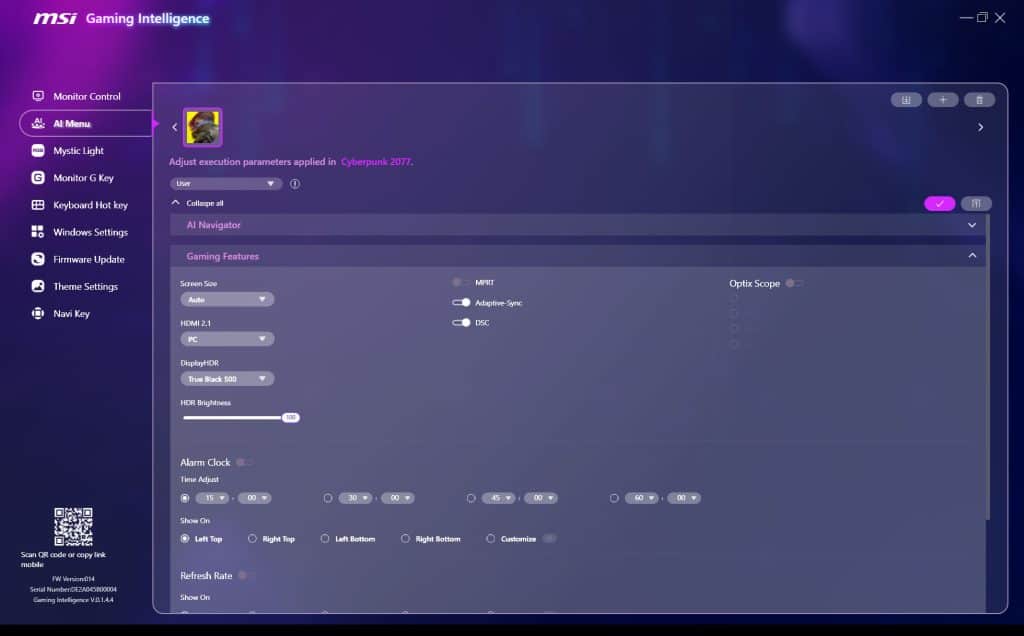
We re-tested the EOTF Boost mode, which you can check out here. We also added photos of the Gaming Intelligence application, which is now supported.
It’s been over three years since Dell released the Alienware AW3423DW with its first-generation QD-OLED panel, and aside from a small refresh rate bump to 240Hz in newer models, fans of the 34″ ultrawide form factor haven’t seen much progress. Meanwhile, other display formats have benefited from improvements to subpixel layouts and brightness performance.
That changes today!
The MSI MPG 341CQR QD-OLED X36 introduces a brand-new 5th-generation QD-OLED panel with a new V-stripe RGB subpixel layout, higher brightness (1,300 nits for 3% APL), and a long-awaited screen coating upgrade for 2.5x better scratch resistance, 40% deeper blacks, and no magenta tint under ambient lighting thanks to its new DarkArmor Film finish!
On top of that, the monitor features MSI’s advanced OLED Care 3.0 features, the AI Care Sensor, a new design with a smaller footprint, more HDR customization and extensive connectivity options, including USB-C 98W PD and KVM.
Image Quality
OLED displays deliver exceptional image quality, with infinite contrast and per-pixel dimming that produce true blacks without the blooming often seen on mini LED backlights.
They also offer excellent brightness for punchy highlights, rich and vibrant colors with 99.3% DCI-P3 coverage, true 10-bit color depth for smooth gradients, and wide 178° viewing angles that maintain excellent consistency from virtually any position.
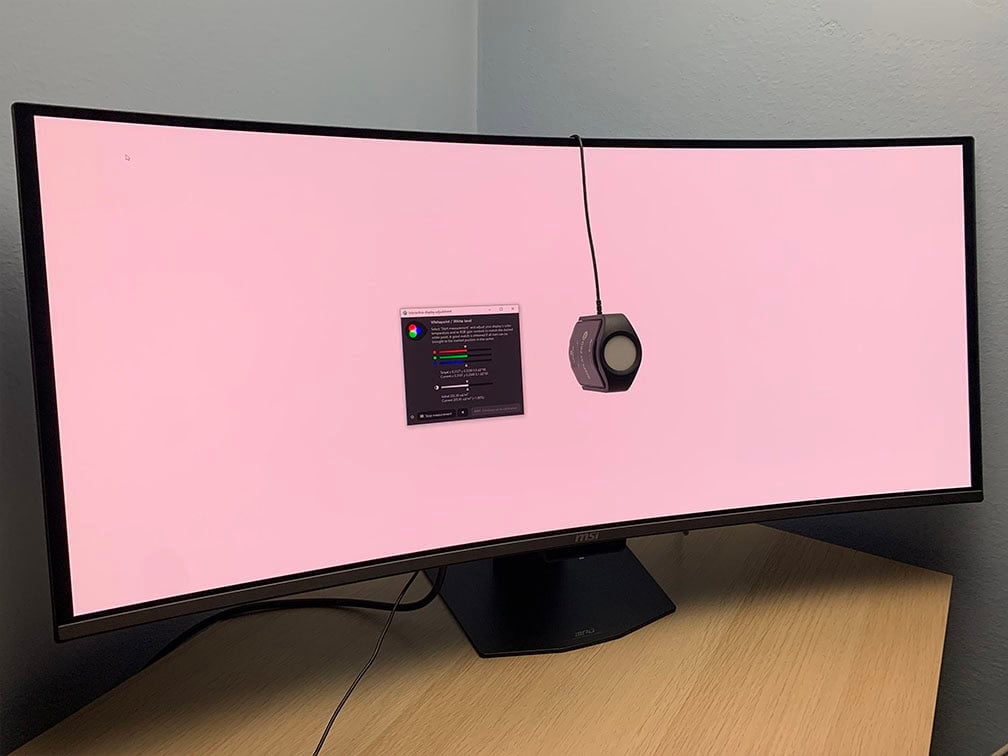
For our testing, we’re using the Calibrite Display Pro HL colorimeter paired with DisplayCAL and HCFR software. Note that our tests were done using the FW.009 monitor firmware version on an early sample of the monitor.
Subpixel Layout & Pixel Density
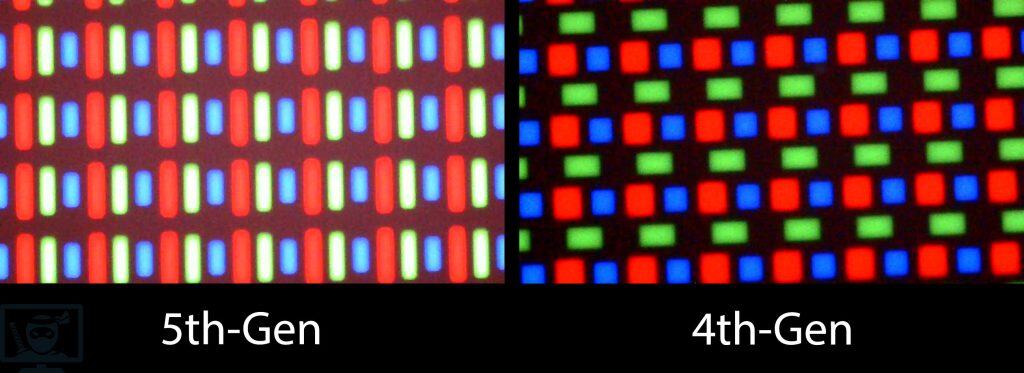
First, let’s have a look at the all-new true V-stripe RGB subpixel layout!
As you can see, the subpixel layout is no longer in a triangular share like it was on previous-gen QD-OLED panels. The red and green subpixels are longer than the blue subpixel – unlike with typical RGB layouts, where all subpixels are the same length, but in real use, there is no colored fringing on small text and fine details.
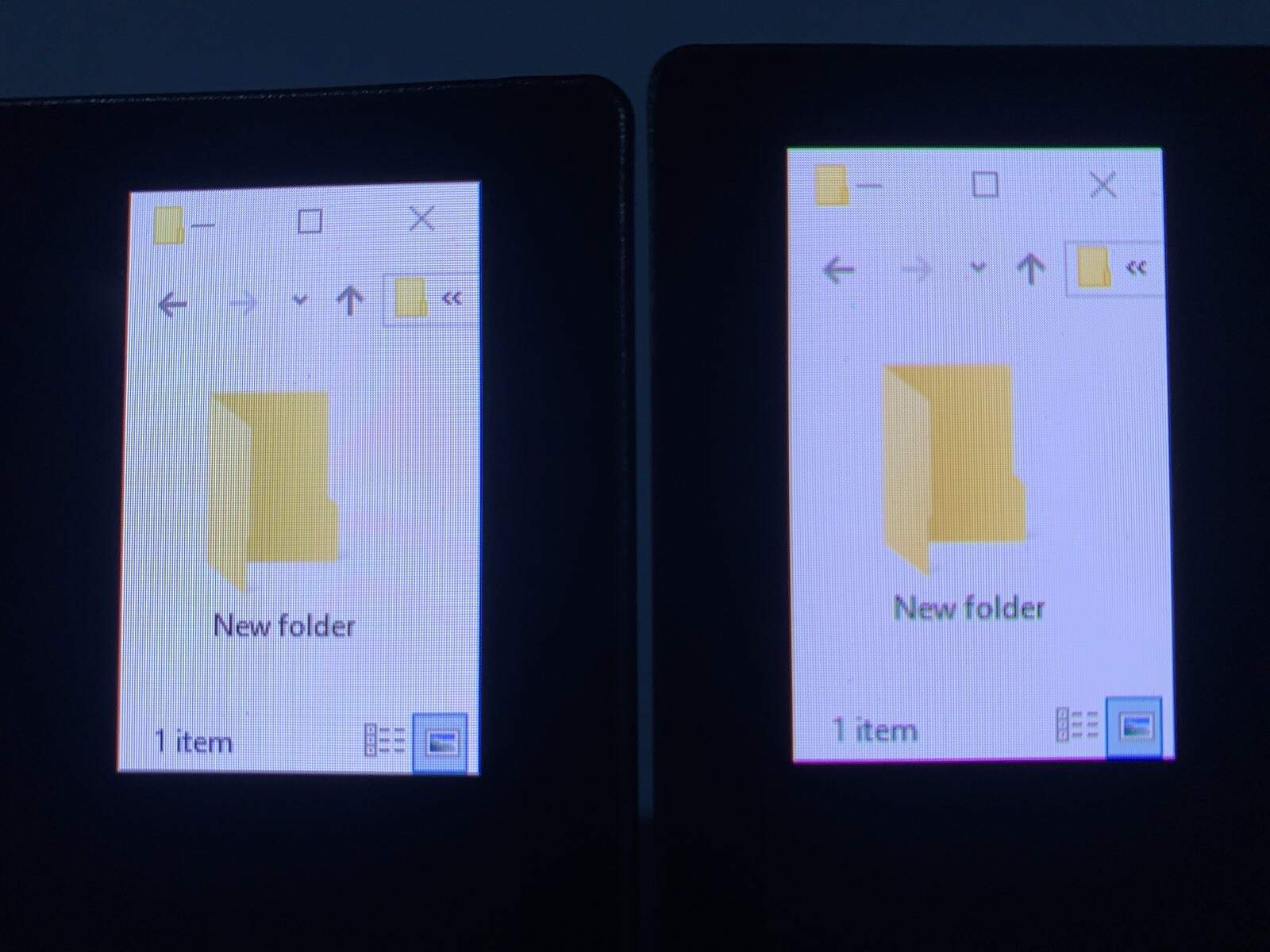
Here’s the image of the MSI MPG 341CQR X36 next to the MSI MPG 271QR X50, which uses the 4th-gen QD-OLED panel. Both monitors also have roughly the same pixel density.
Click to enlarge.
Notice the thin green line at the top of the window and the magenta line at the bottom on the MSI MPG 271QR X50 (right). There’s also some green and magenta fringing around the ‘New folder’ text.
In comparison, the MSI MPG 341CQR X36 on the left shows virtually no fringing, aside from a faint red line along the left edge of the window.
Moving on, the 3440×1440 UWQHD resolution on a 34″ sized screen provides you with a pixel density of around 110 PPI (pixels per inch), resulting in reasonably sharp details and text, as well as plenty of screen real estate.
The 21:9 ultrawide format offers extra horizontal screen space, a wider field of view in compatible games and a better video watching experience of movies shot at ultrawide aspect ratios.
Color Gamut
We measured an impressive 163.6% sRGB color gamut volume with 99.6% sRGB, 97.1% DCI-P3 and 95.9% Adobe RGB color space coverage.
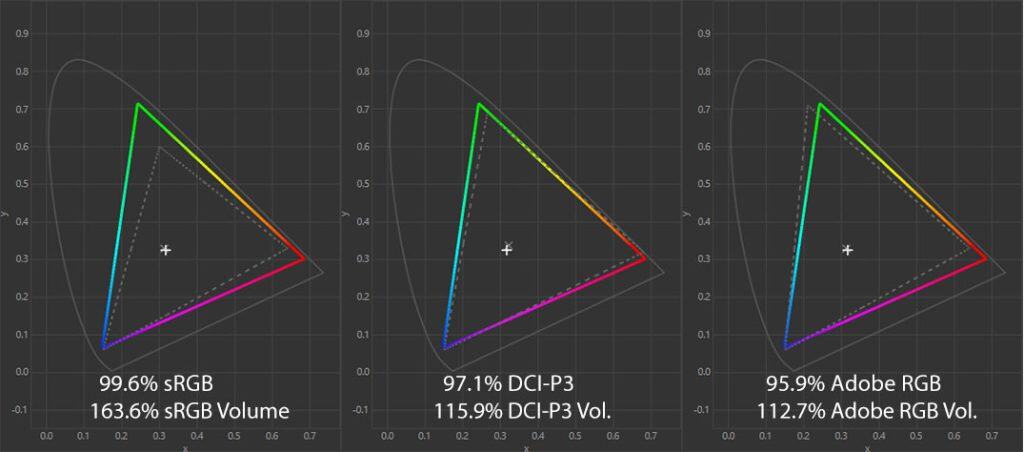
The DCI-P3 coverage here is a tad lower than the specified 99.3% DCI-P3 for QD-OLED panels, which is a result of different colorimeters and testing methods.
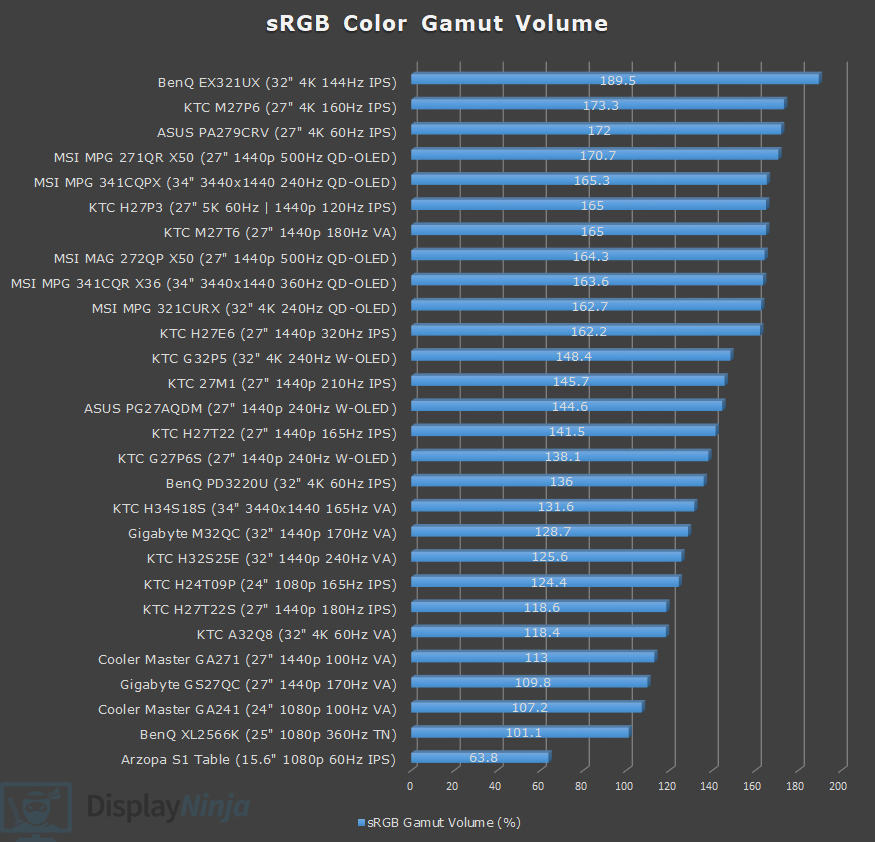
Image Accuracy
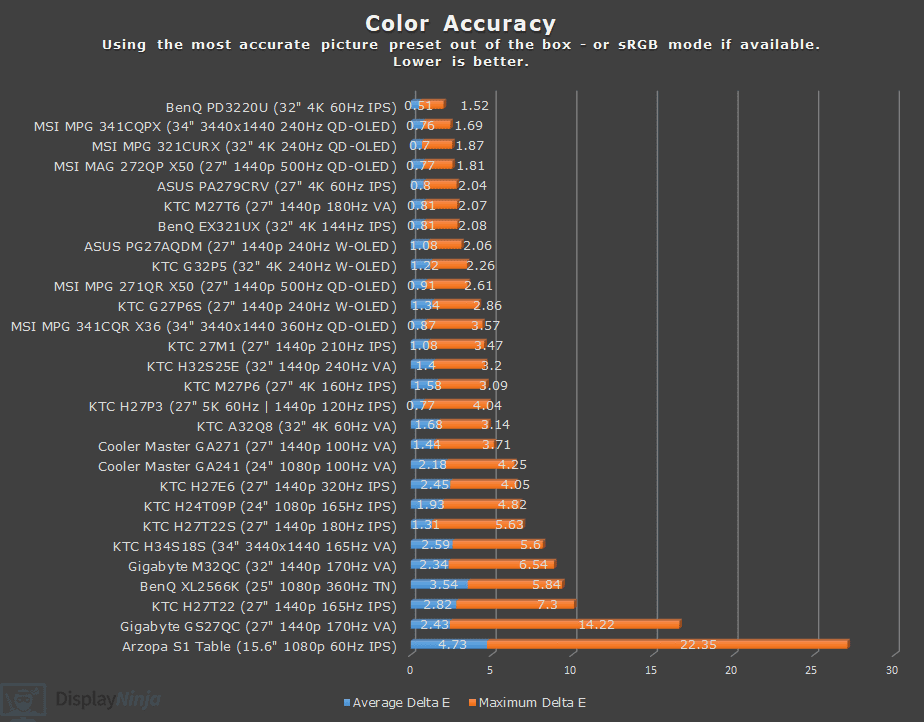
As Windows doesn’t do color management by default, the colors will be oversaturated when viewing SDR content out of the box in the ‘User’ or ‘Eco’ mode, with a Delta E of 3.2 average (color deviation from the target, less than 1.5 is considered good) and 7.73 maximum (target is less than 3).
Selecting the ‘sRGB’ option under ‘Mode’ in the OSD (On-Screen Display) menu will clamp the color gamut from 163.6% volume down to 100.1% with 97% sRGB color space coverage.
This results in a more accurate Delta E of 0.87 average and 3.57.

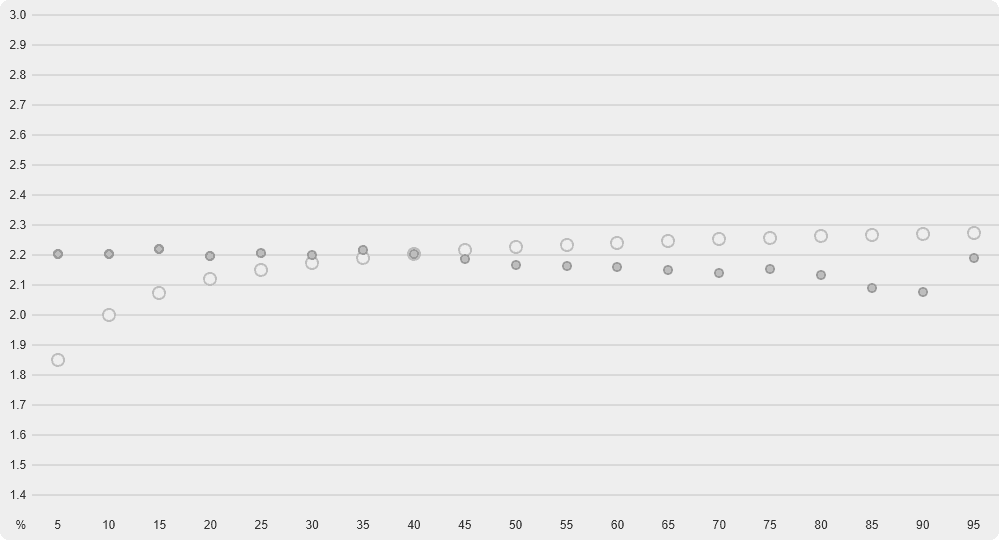
Gamma tracking is also excellent, with an average of 2.16 (target is 2.2), and it follows the sRGB tone curve properly, though some lighter shades will be a bit brighter than intended.
In the ‘User’ mode, the gamma average is closer to 2.2 at 2.17, but it’s targeting a flat 2.2 gamma instead, which can make details in dark scenes a bit darker than intended, in addition to some lighter shades appearing brighter than they should be.
The color temperature in all modes is around 6250K, which is slightly lower than the 6500K target, but there’s no noticeable tinting to the whitepoint.
There are six color temperature options:
- 5000K – we measured 4886K
- 6500K – 6250K
- 7500K – 7073K
- 9300K – 8564K
- 10000K – 9103K
- Customize – 6174K by default
You can adjust brightness, gamma and color temperature in all modes, including User, sRGB, DCI-P3 and Adobe RGB.
We also tested the Adobe RGB and DCI-P3 modes.
The Adobe RGB mode clamps the gamut to 94.2% with 92.1% coverage, a Delta E of 1.03 average and 3.68 maximum, and 2.18 gamma.
The DCI-P3 mode reduces the gamut volume to 100.8% with 97% coverage, Delta E of 1 average and 2.98 maximum, and flat 2.2 average gamma.
There are several other modes, including Premium Color (increases oversaturation even further), FPS, Racing, RTS, RPG, Eco, Movie and Office, but we don’t recommend using these as they’re inaccurate.
When you enable HDR in Windows, the monitor maps colors to sRGB, with a Delta E of 0.98 average and 2.47 maximum, 6233K color temperature, and a 2.19 average gamma with a correct sRGB tone curve. However, it clamps the gamut a bit too much, with a 91.5% sRGB gamut volume and 91% coverage.
We also don’t recommend enabling HDR in Windows unless you’re watching HDR content in order to avoid ABL (Automatic Brightness Limiter), which we’ll get into later.
All in all, the SDR accuracy of the MSI MPG 341CQR QD-OLED X36 monitor out of the box is decent. The maximum Delta E in the sRGB mode is a bit higher than ideal, which matches the factory calibration report we got with the monitor.
For most people, it’s accurate enough for everyday use. For color-critical work, using a colorimeter can help improve accuracy.
Calibration
For full calibration, we set the brightness to 28/100 to get around 120-nits and used the ‘Customize’ color temperature mode with red, green and blue channels set to 98, 97 and 100, respectively, for 6489K.
We got a low Delta E of 0.43 average and 3.04 maximum, and 2.2 average gamma with proper sRGB tone curve tracking.
You can download our ICC profile here.
Brightness & Contrast
Because each pixel on an OLED display can turn off completely, it delivers true blacks and an effectively infinite contrast ratio, without the blooming artifacts often associated with mini LED full-array local dimming (FALD) displays.
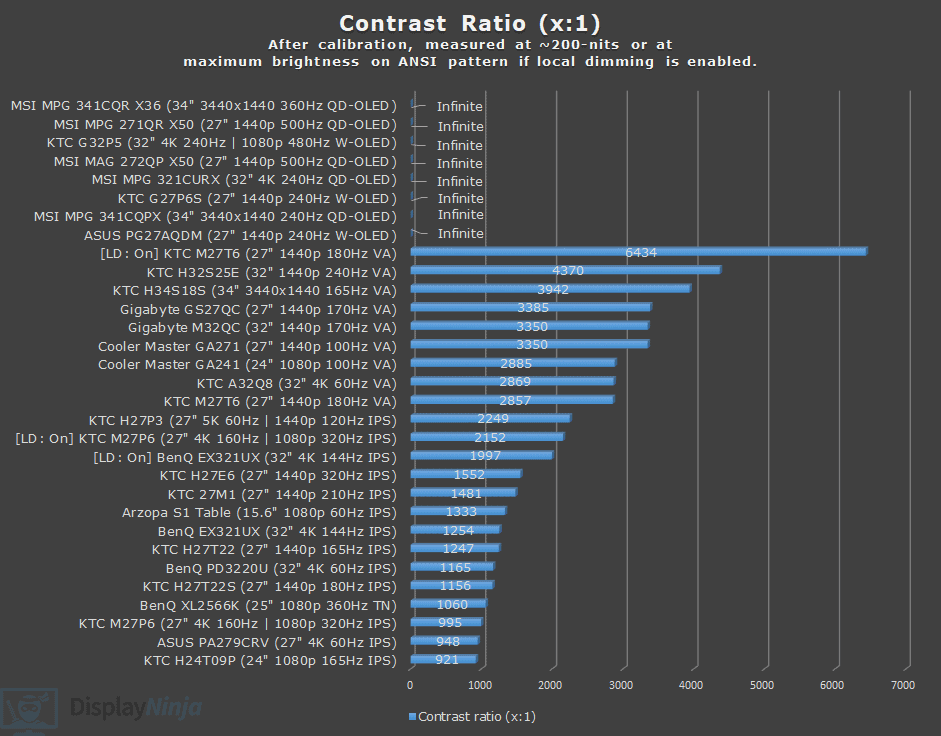
The MSI MPG 341CQR X36 is certified for VESA DisplayHDR True Black 500, an upgrade over the previous True Black 400 models.
Additionally, it boasts Samsung’s new TrueBright 500 certification, which aims to rank displays based on perceived brightness by also taking contrast into account, unlike VESA DisplayHDR, which mainly focuses on brightness. According to this, a 300-nit OLED display has a brightness performance equivalent to a 510-nits LCD.
The new panel raises the specified brightness from 250 nits to 300 nits at 100% APL (Average Picture Level, white window test) and from 450 nits to 500 nits at 10% APL.
In SDR mode, the maximum brightness reaches a consistent 306-nits. There’s no ABL in SDR mode, meaning the brightness doesn’t change based on how many bright elements are on the screen, which is a behavior most users prefer.
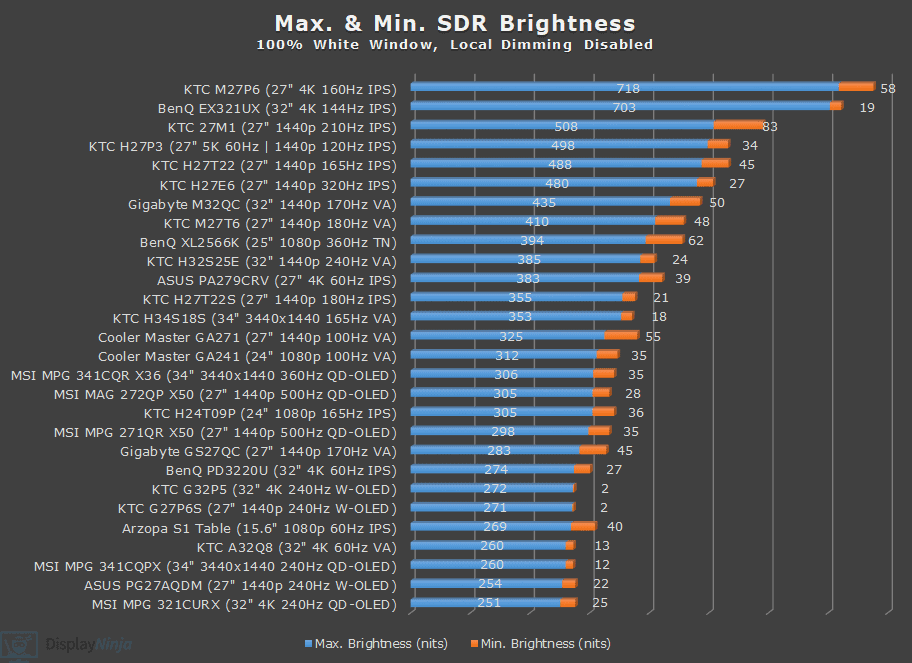
The minimum brightness is 35-nits, making the monitor suitable for use in both dark and bright rooms.
HDR
The MSI MPG 341CQR QD-OLED X36 has three main HDR modes: True Black 500, Peak 1300 nits and EOTF Boost.
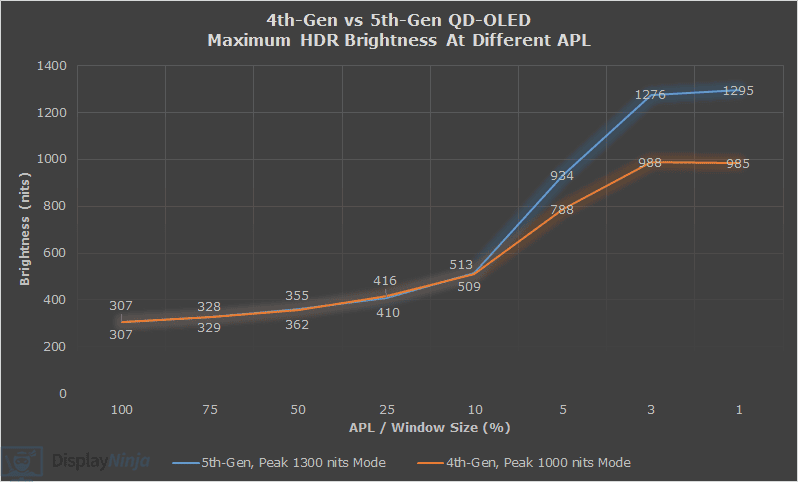
In synthetic tests (white window against a black background), True Black 500 is limited to 507-nits, while the Peak 1300 nits and EOTF Boost have the same performance, reaching up to 1295-nits for 1% APL.
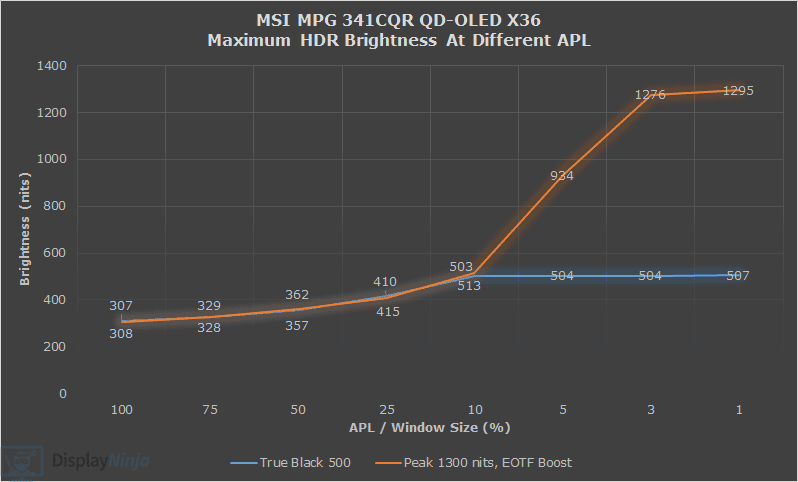
You get a notable 30% brightness boost for 1% – 3% APL in comparison to previous-gen QD-OLED panels with Peak 1000 nits, as well as almost 20% brightness increase for 5% APL. Here’s how the MSI 341CQR X36 compares to the MSI MPG 271QR QD-OLED X50, for instance.
Moving on, in real-use HDR content viewing, brightness behavior changes between the three modes due to different EOTF tracking.
In the charts below, you can check out the accuracy of all modes. The gray line is the target brightness, and the yellow line is the monitor’s brightness.
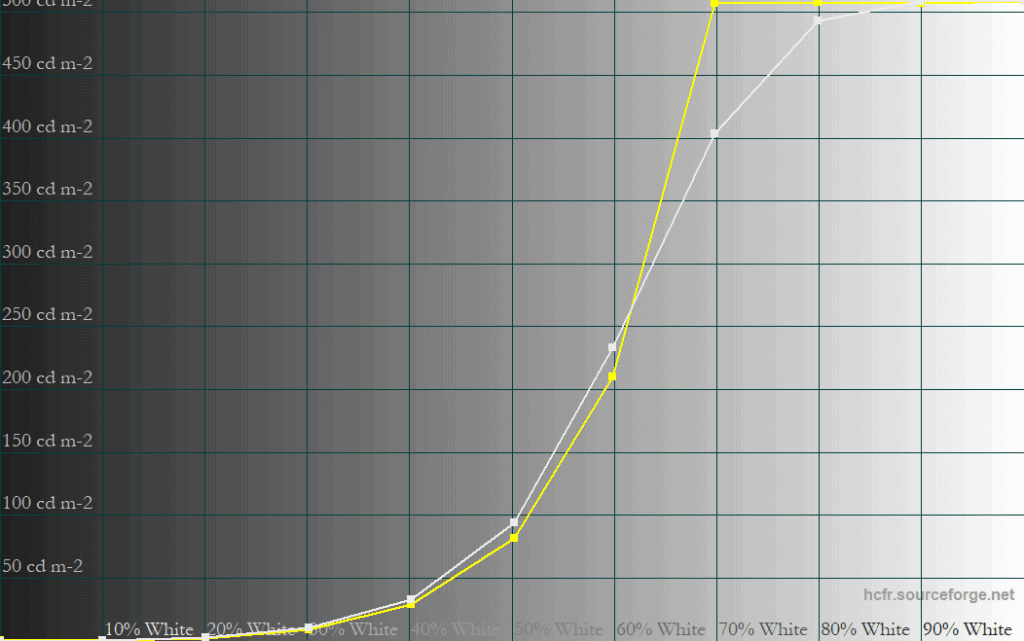
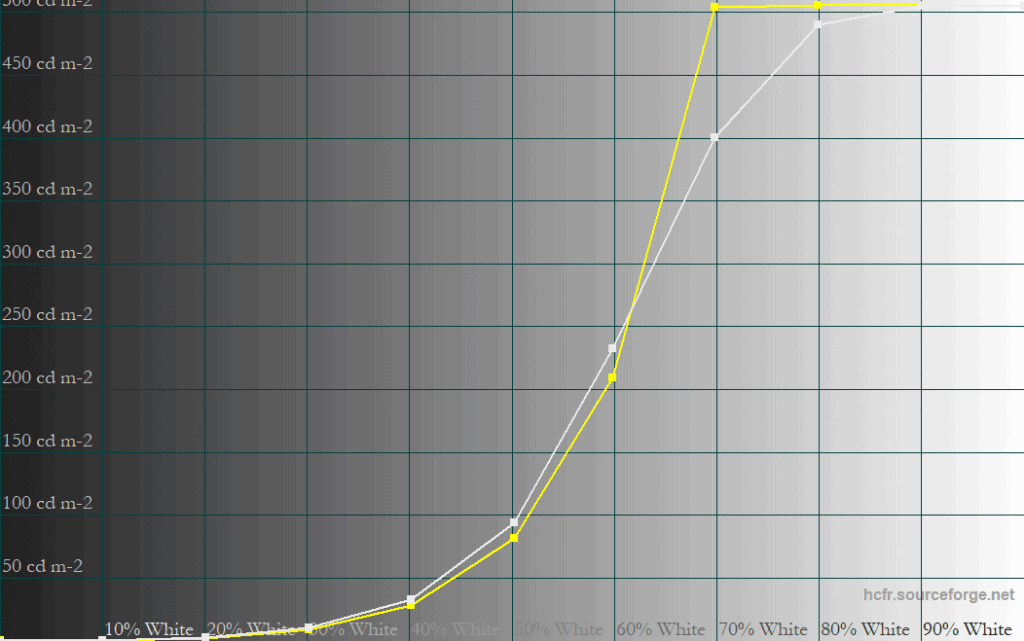
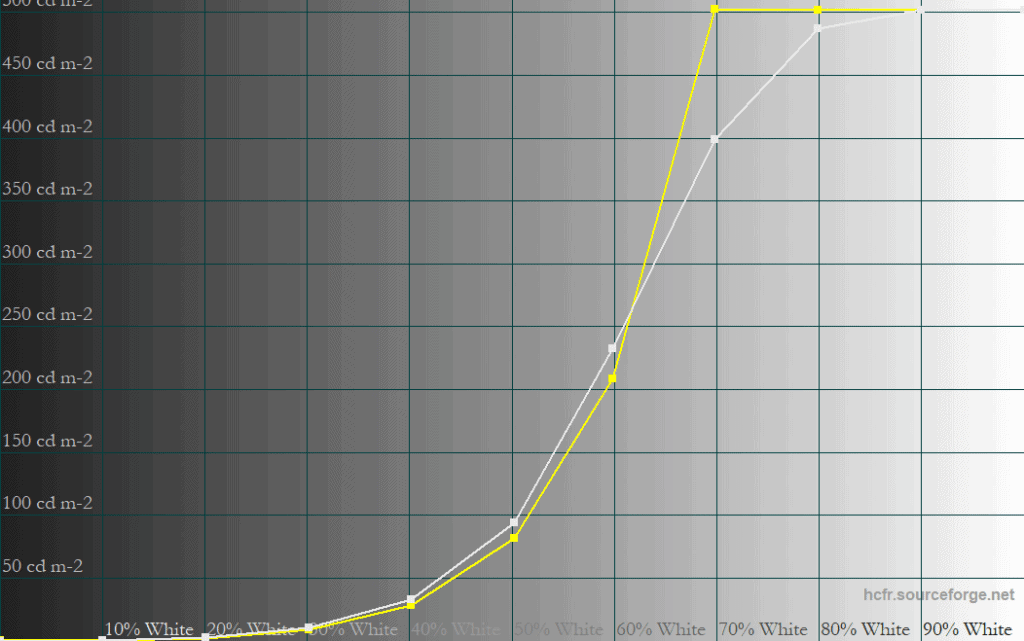
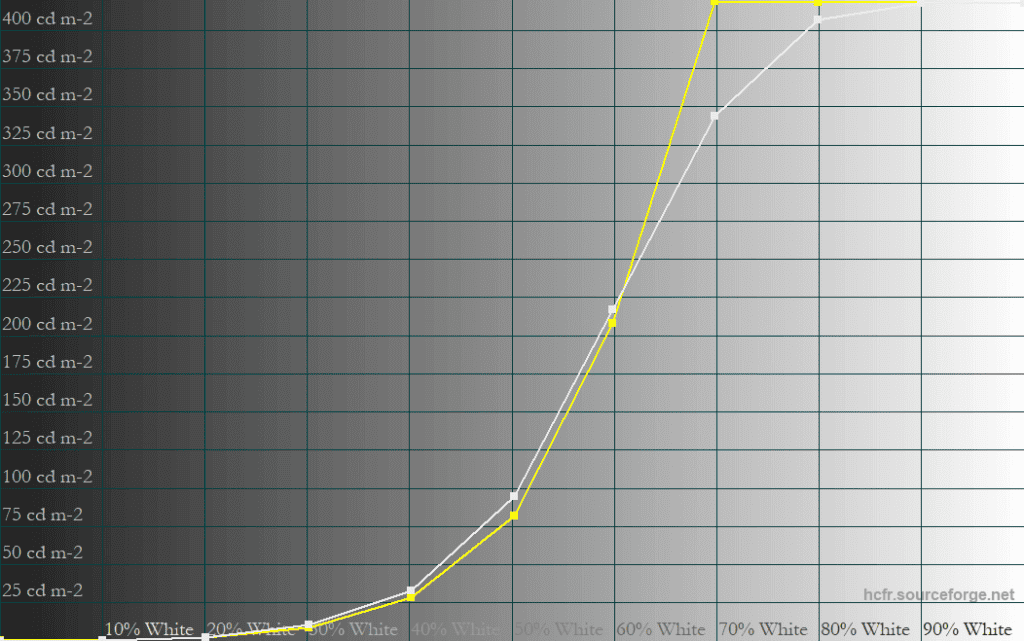
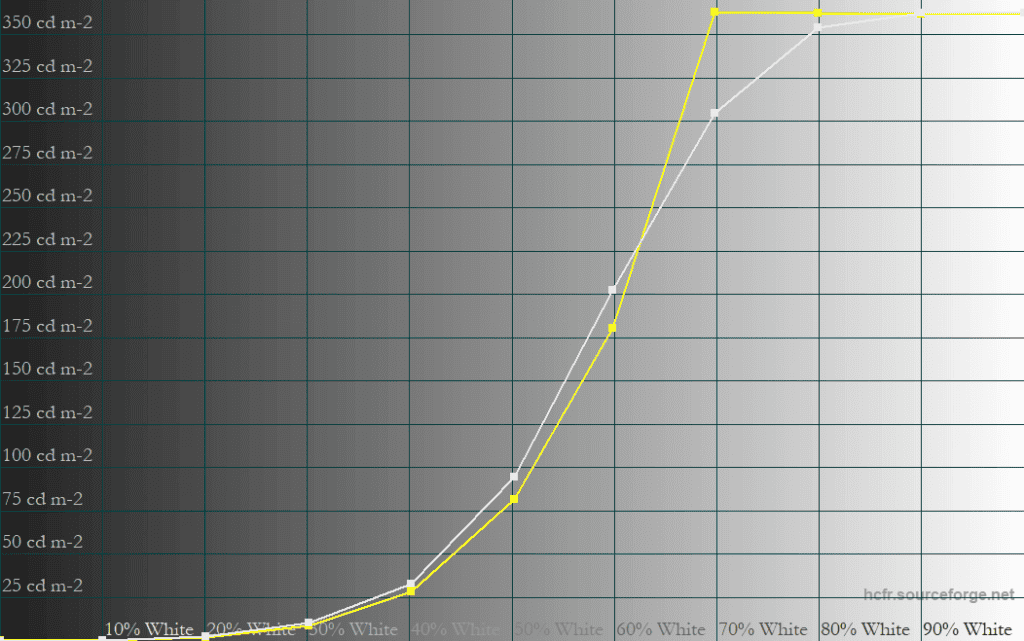
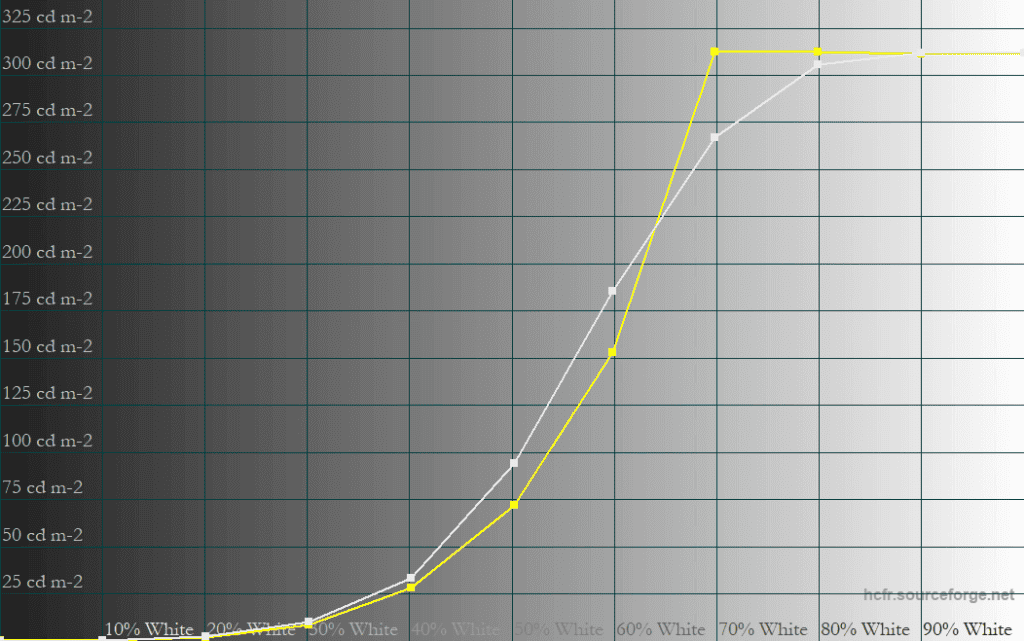
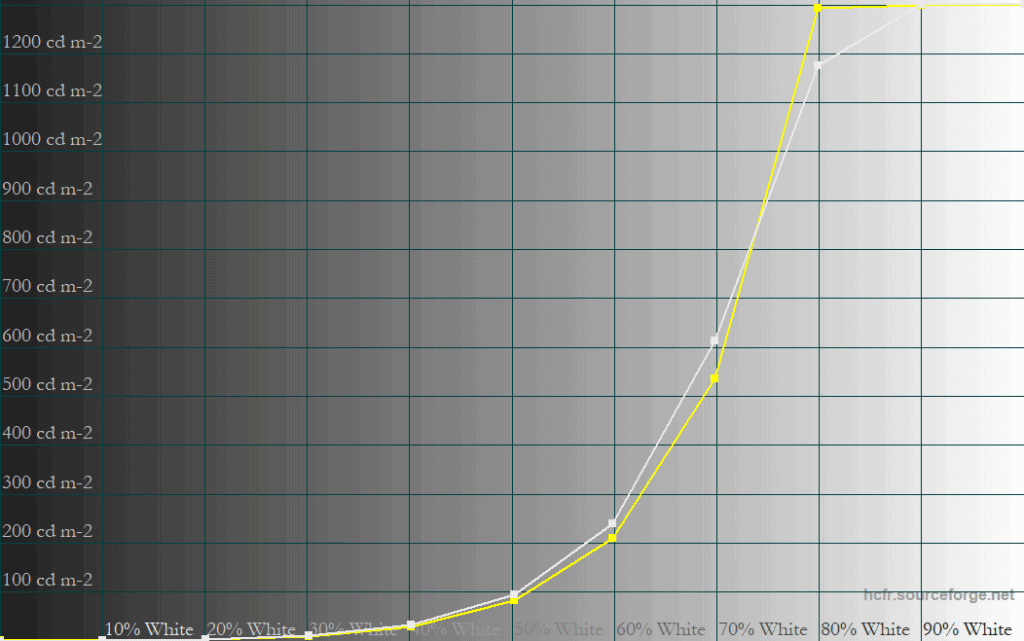
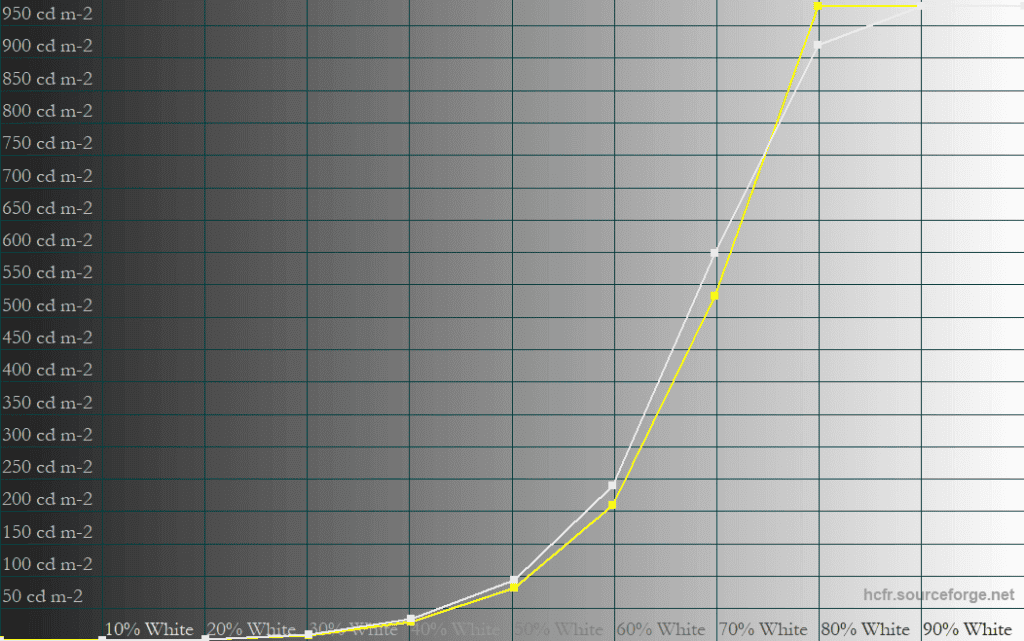
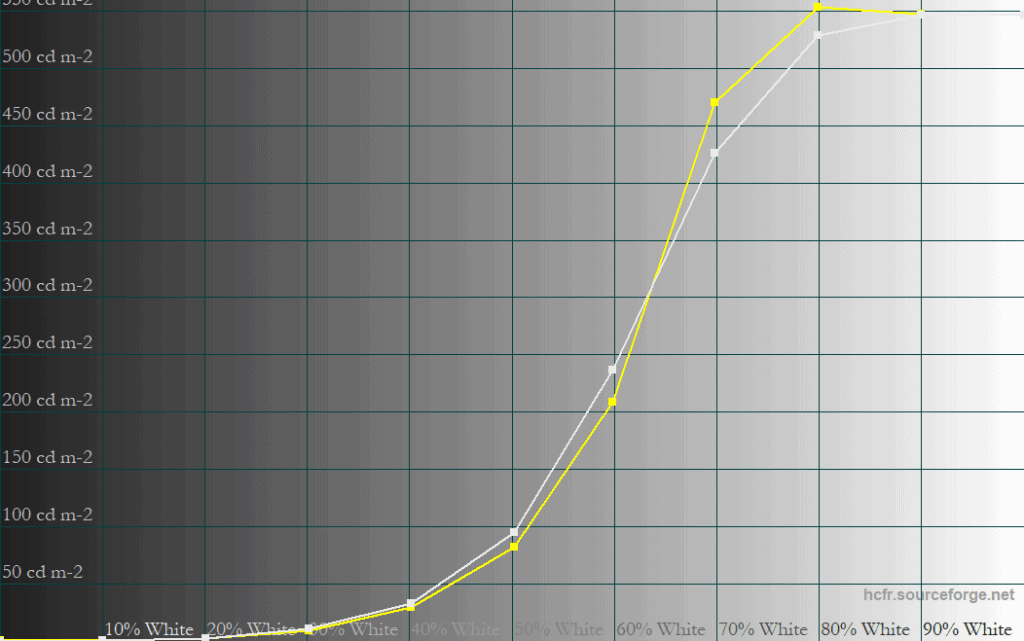
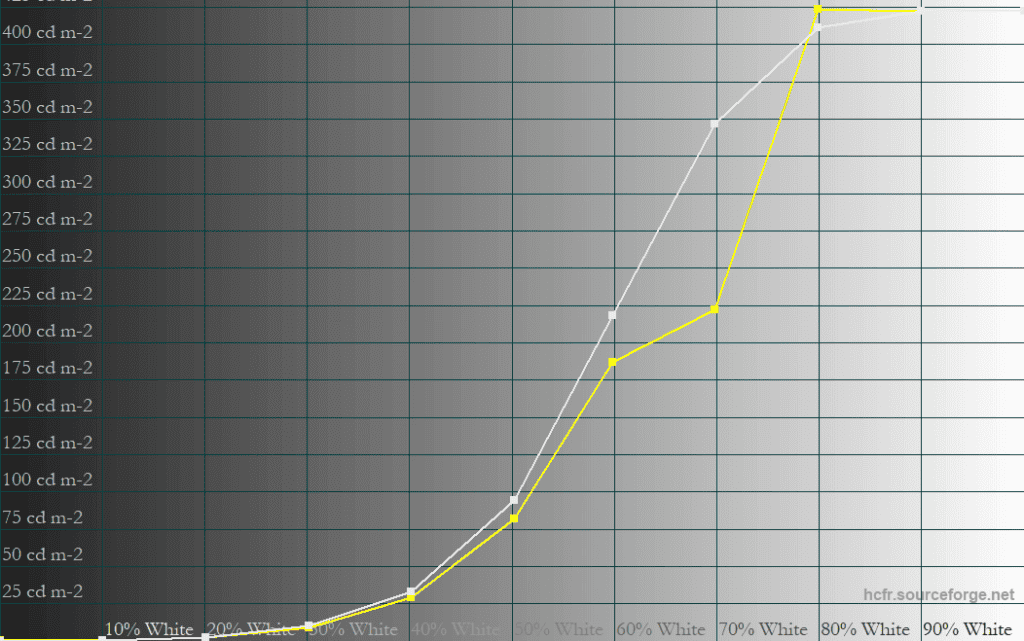
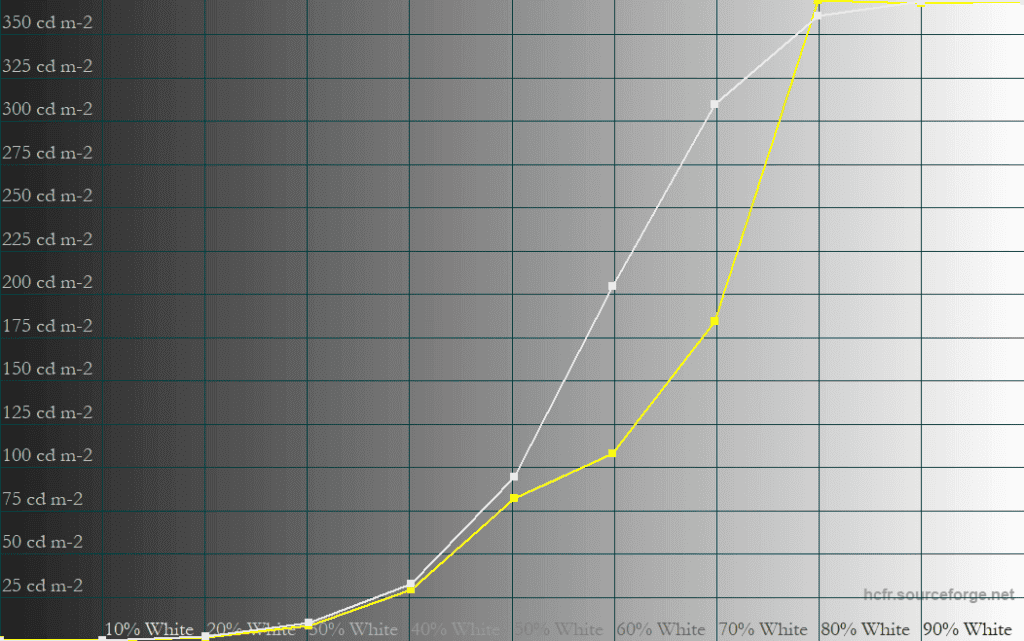
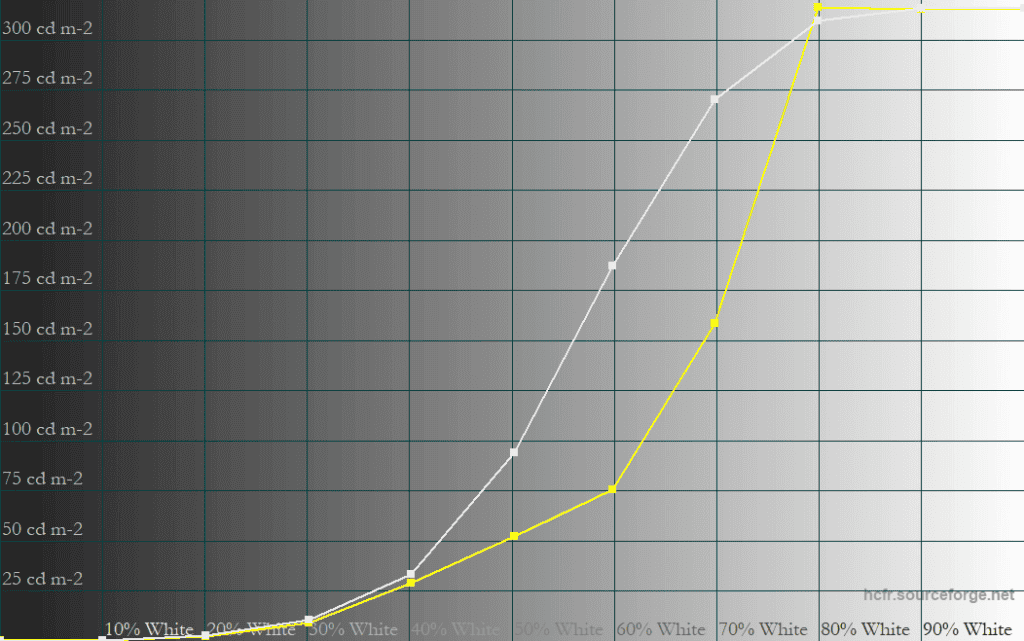
As is the case with all QD-OLED monitors, the True Black 500 mode is more accurate but limited to around 500-nits, while the Peak 1300 nits mode can achieve higher brightness levels (up to 1300-nits for small highlights), but its brightness is notably lower for large APLs (25% – 100%).
This causes the screen to look brighter in True Black 500 mode when there are large bright elements on the screen, whereas the Peak 1300 nits mode offers punchier highlights with small bright elements.
This is the same behavior we’ve seen with all monitors using Samsung’s QD-OLED panels and Samsung claims this panel dimming exists due to power management.
The EOTF Boost is MSI’s attempt to circumvent QD-OLED’s limitations by combining the two modes.
With the old FW.009 firmware version, the EOTF Boost mode wasn’t particularly useful. Luckily, the FW.014 version improves the performance.
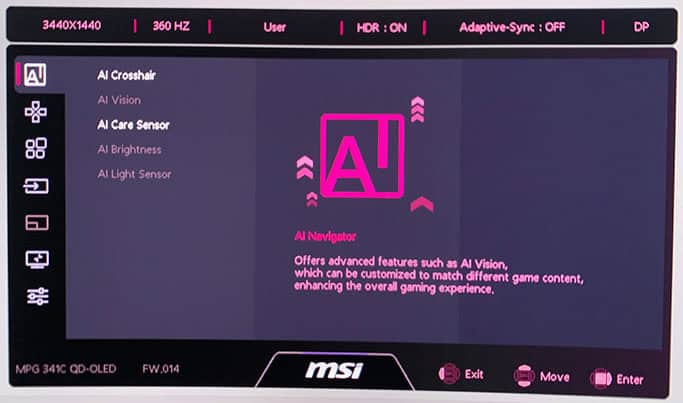
The EOTF Boost mode allows you to keep the high 1300-nit peak brightness with small highlights. 1 – 10% APLs are now even slightly brighter than intended on areas that were a bit darker than intended on the Peak 1300 nits mode.
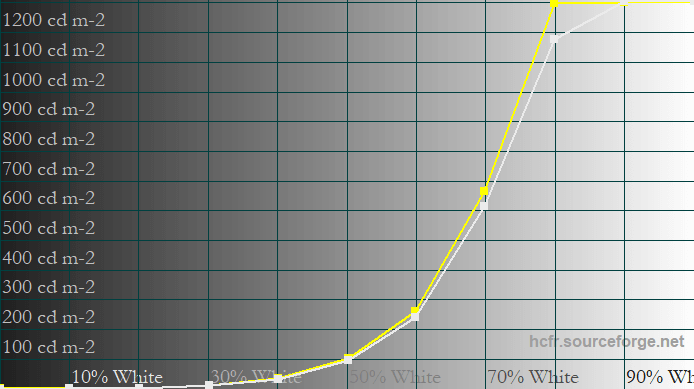
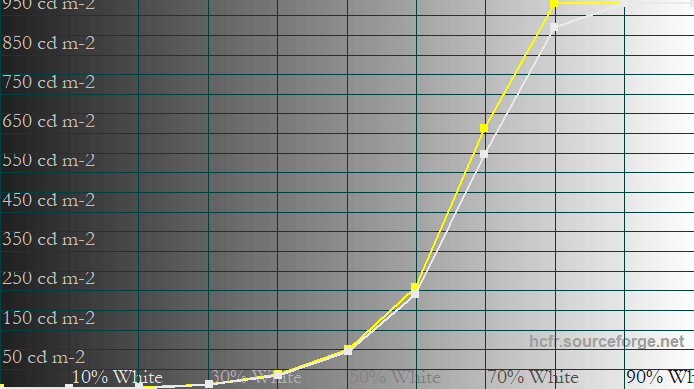
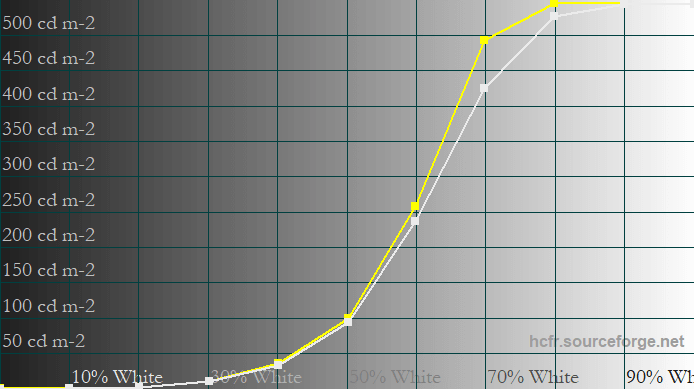
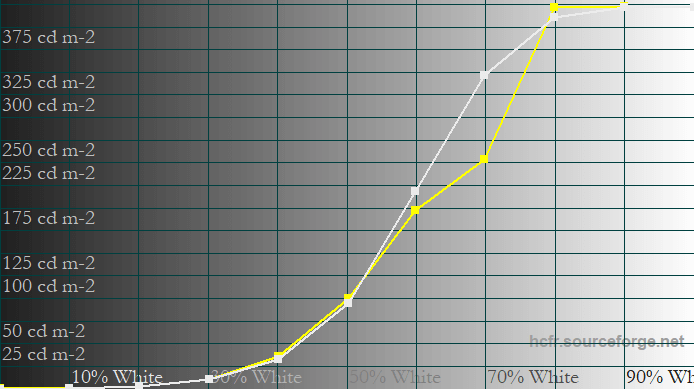
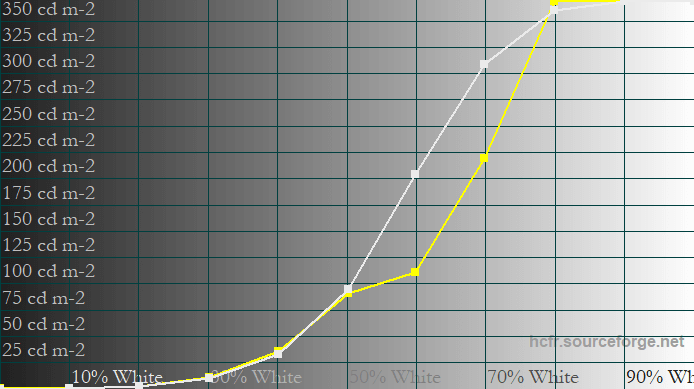
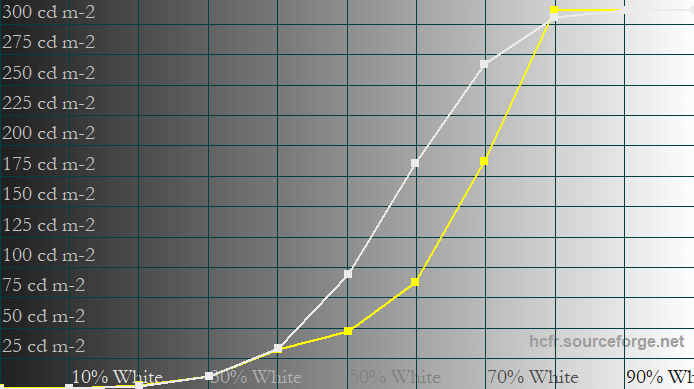
For large APLs, the EOTF Boost mode is still largely darker than intended and not as bright as True Black 500, but it’s still a bit brighter than the Peak 1300 nits mode. So, we recommend going with the EOTF Boost mode.
Here’s how all this plays out in some real-world content.
Sunlight in ‘A Perfect Planet’ | Small flash from ‘Chasing The Light’ | Large flash from ‘Chasing The Light’ | Lightning in ‘A Perfect Planet’ | Solar flare in ‘A Perfect Planet’ | Sunlight in‘ A Perfect Planet’ | |
| MSI MPG 341QR X36 (QD-OLED) True Black 500 | 466 | 500 | 389 | 499 | 210 | 221 |
| MSI MPG 341QR X36 (QD-OLED) Peak 1300 nits | 647 | 1228 | 400 | 545 | 112 | 129 |
| MSI MPG 341QR X36 (QD-OLED) EOTF Boost FW.009 | 379 | 815 | 293 | 511 | 148 | 152 |
| MSI MPG 341QR X36 (QD-OLED) EOTF Boost FW.014 | 765 | 1295 | 409 | 760 | 129 | 137 |
| MSI MAG 272QP X50 (QD-OLED) True Black 500 | 497 | 525 | 377 | 514 | 209 | 224 |
| MSI MAG 272QP X50 (QD-OLED) Peak 1000 nits | 558 | 863 | 395 | 567 | 129 | 140 |
| MSI MAG 272QP X50 (QD-OLED) EOTF Boost | 580 | 845 | 366 | 556 | 319 | 322 |
| MSI MPG 271QR X50 (QD-OLED) True Black 500 | 481 | 502 | 368 | 495 | 210 | 230 |
| MSI MPG 271QR X50 (QD-OLED) Peak 1000 nits | 544 | 814 | 385 | 539 | 127 | 139 |
| MSI MPG 271QR X50 (QD-OLED) EOTF Boost | 553 | 724 | 376 | 760 | 174 | 184 |
| MSI MPG 321CURX (QD-OLED) True Black 400 | 429 | 452 | 310 | 450 | 201 | 207 |
| MSI MPG 321CURX (QD-OLED) Peak 1000 nits | 538 | 974 | 328 | 549 | 108 | 113 |
| KTC G27P6S (W-OLED MLA+) | 317 | 739 | 313 | 602 | 183 | 216 |
| KTC G32P5 (W-OLED MLA+) | 240 | 467 | 305 | 572 | 170 | 205 |
| KTC M27P6 (Mini LED IPS) VESA DisplayHDR, Low | 837 | 1224 | 1751 | 645 | 385 | 394 |
| KTC M27P6 (Mini LED IPS) HDR Cinema, Low | 745 | 1096 | 1416 | 591 | 334 | 349 |
| KTC M27T6 (Mini LED VA) Display HDR, Low | 1263 | 1298 | 1642 | 1173 | 837 | 859 |
| KTC M27T6 (Mini LED VA) HDR Game, Standard | 695 | 674 | 1316 | 615 | 536 | 542 |
| BenQ EX321UX (Mini LED IPS) | 792 | 1140 | 1440 | 579 | 309 | 317 |
As you can see, the EOTF Boost mode is a bit brighter than the Peak 1300 mode with the ‘Sunlight’ and ‘Lightning’ scenes from ‘A Perfect Planet’, while the last two scenes are also brighter than the Peak 1300 mode, but aren’t as bright as True Black 500 or the EOTF Boost mode on the MSI MPG 271QR QD-OLED X50.
Under HDR settings, you’ll also find two Uniform Luminance modes: ‘Cust. (True Black 500)’ and ‘Cust. (Peak 1300)’, which allow you to customize brightness for specific APLs.
By default, these are at maximum values (same as True Black 500 and Peak 1300 nits) and adjusting them won’t affect EOTF tracking, so they’re mainly used to minimize ABL (Automatic Brightness Limiter).

For instance, if you’re viewing a scene that’s mostly dark in a game and then move your mouse up to the sky, you can notice a minor shift in brightness due to ABL. This is more apparent in Peak 1300 nits mode, and it’s an expected behavior on all OLED panels.
With the Custom modes, you can decrease the brightness of 14 individual APL sizes to make ABL less apparent, though we find the brightness trade-off is rarely worth the occasional brightness fluctuation. Still, it’s a great option to have for those sensitive to brightness shifts caused by ABL.
MSI has also added an ‘HDR Brightness’ setting that lets you adjust the maximum brightness.
HDR Saturation & Color Temperature
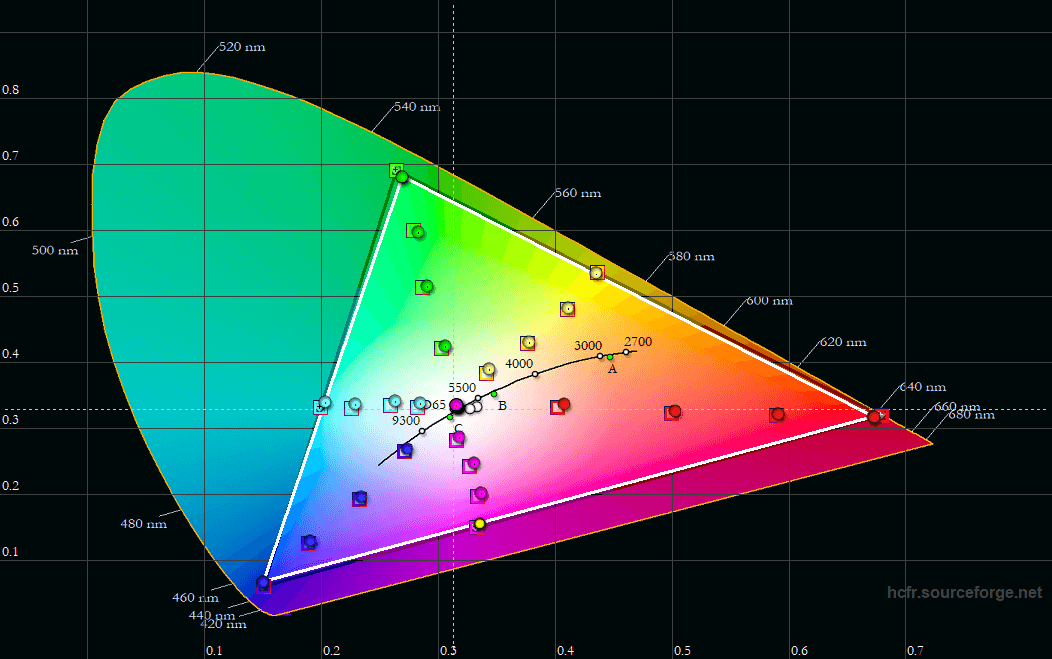
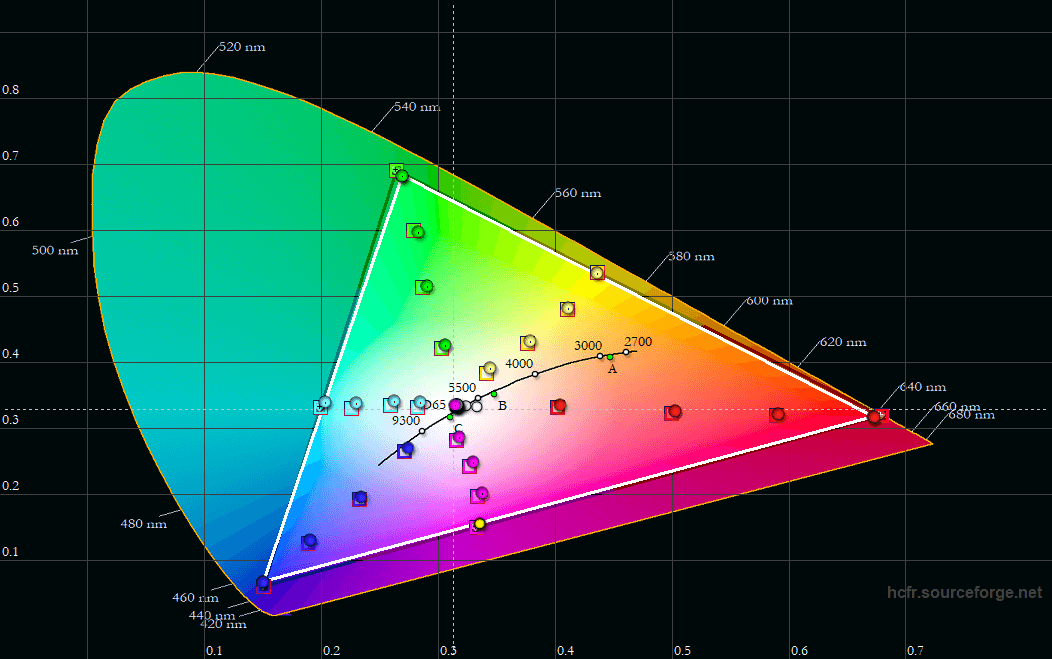
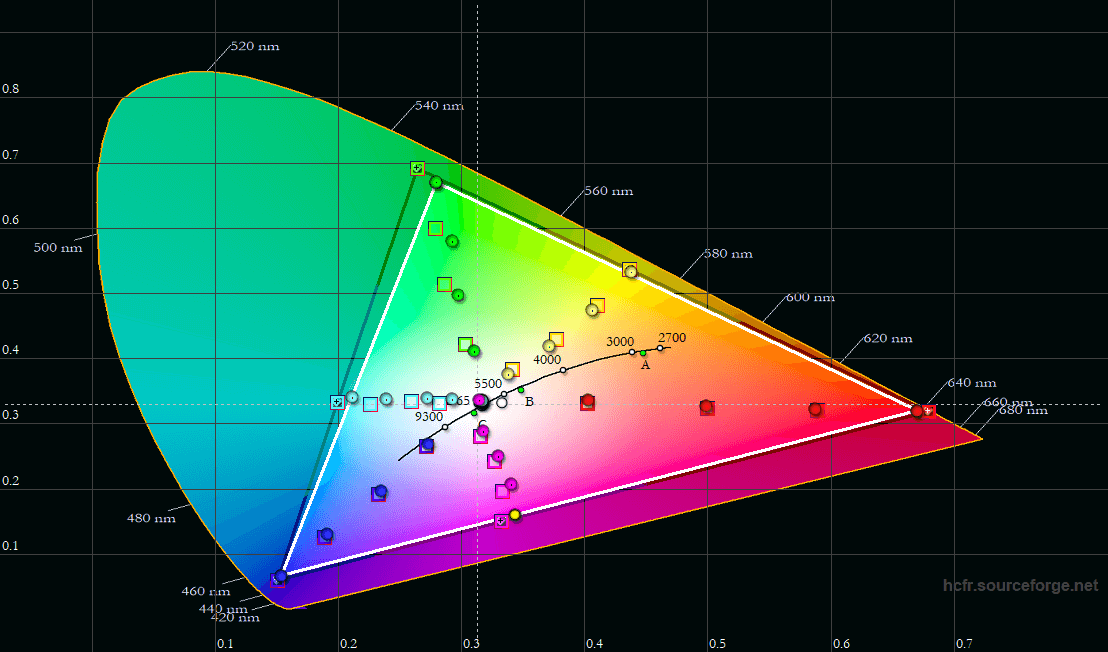
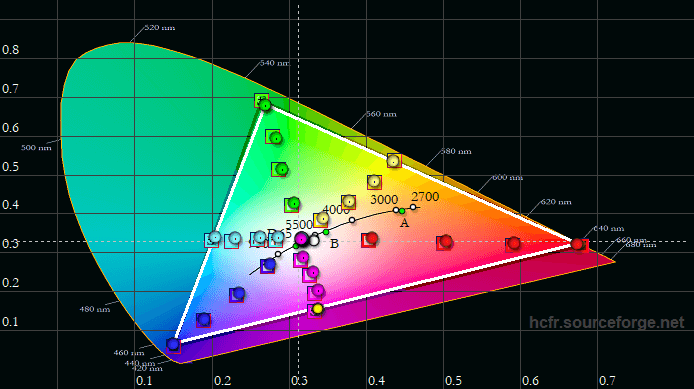
The new FW.014 firmware version also improves the color saturation of the EOTF Boost, which now makes it as accurate as the other modes.
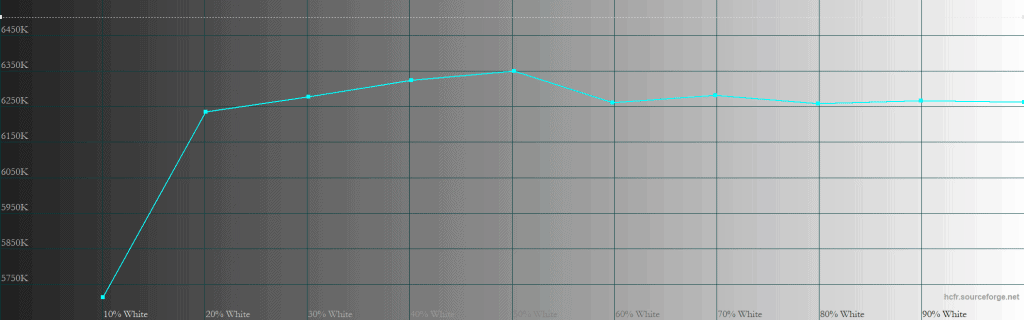
Color temperature is around 6200K in all three HDR modes, which is a bit below the 6500K target, but there’s no noticeable tinting to the whitepoint.
QD-OLED vs W-OLED vs Mini LED
Here’s the 10-minute static stress test. Brightness doesn’t decrease over time.
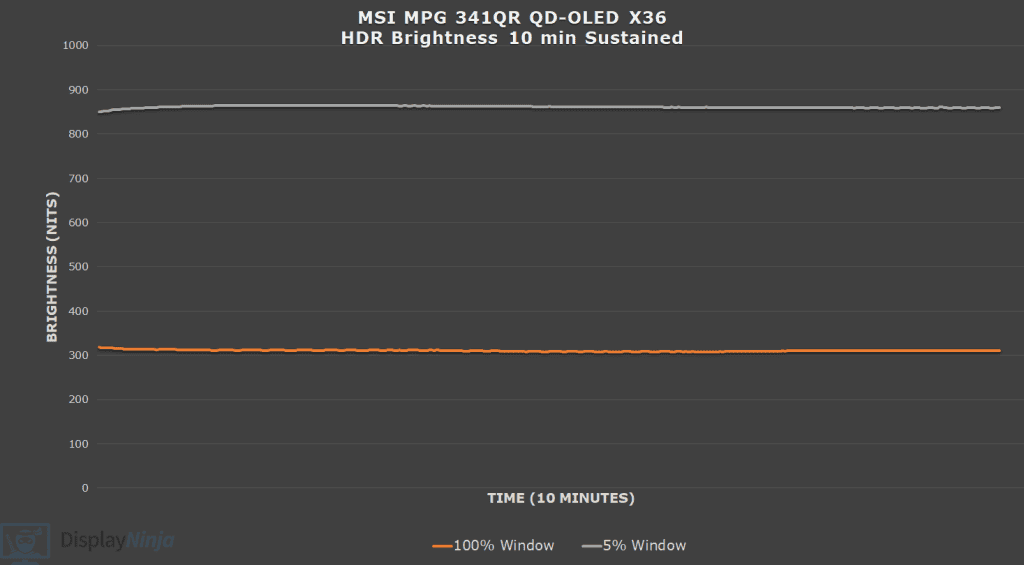
In the chart below, you can see how the brightness of the MSI MPG 341CQR X36 compares to a few other HDR monitors we tested, including the MSI MPG 321CURX with a previous-gen HDR True Black 400 panel.
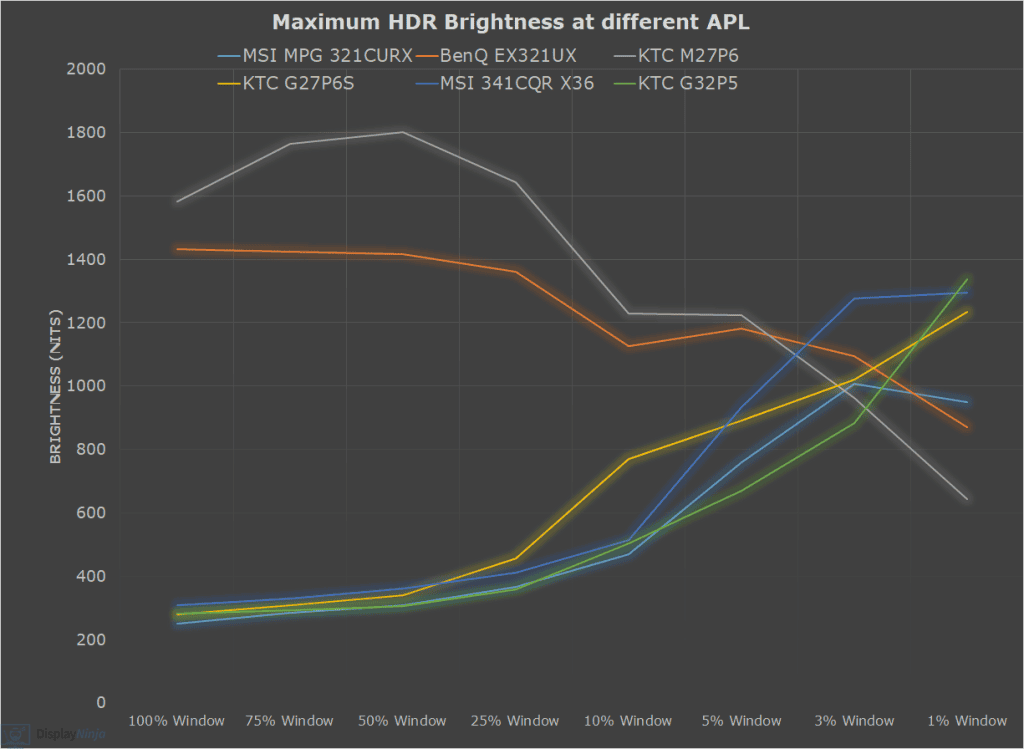
While the KTC G27P6S with LG’s W-OLED MLA+ panel, for example, has a higher 10% APL brightness in this chart, note that this refers to white luminance. When it comes to color luminance, Samsung’s QD-OLED panels are brighter, which in addition to their wider color gamut, results in a higher perceived brightness overall.
LG’s newer Tandem W-OLED panels have an even higher 1500-nit white luminance and higher color luminance than previous-gen W-OLED panels, though their color luminance is still lower than that of QD-OLED.
Here’s how color luminance compares between three QD-OLED panels: the MPG 321CURX with True Black 400 (1000-nits peak), the MPG 271QR X50 with True Black 500 (1000-nits peak), and the MPG 341CQR X36 with True Black 500 (1300-nits peak).
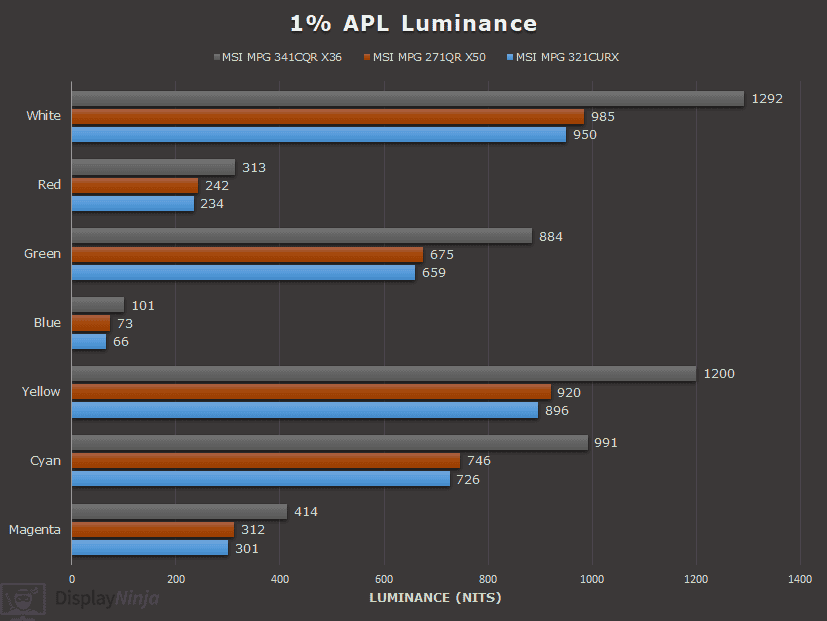
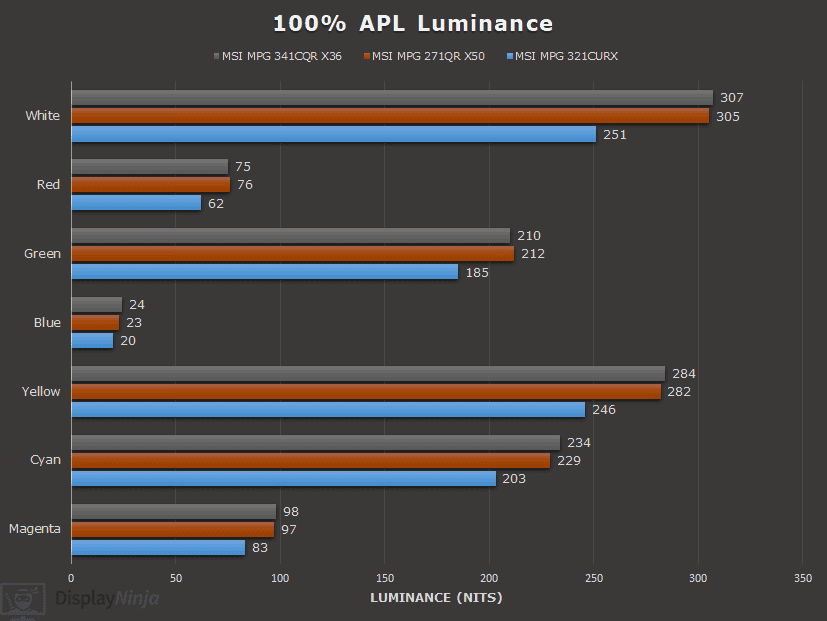
At very low APL levels (around 1 – 5%), color luminance increases in the same way as white luminance on the newest panels. At higher APLs, the last two panel generations show similar improvements compared to the earlier panel.
Next, here’s how color luminance compares between QD-OLED, W-OLED and mini LED monitors we tested. Keep in mind that we still haven’t tested the latest Tandem W-OLED panel, though.
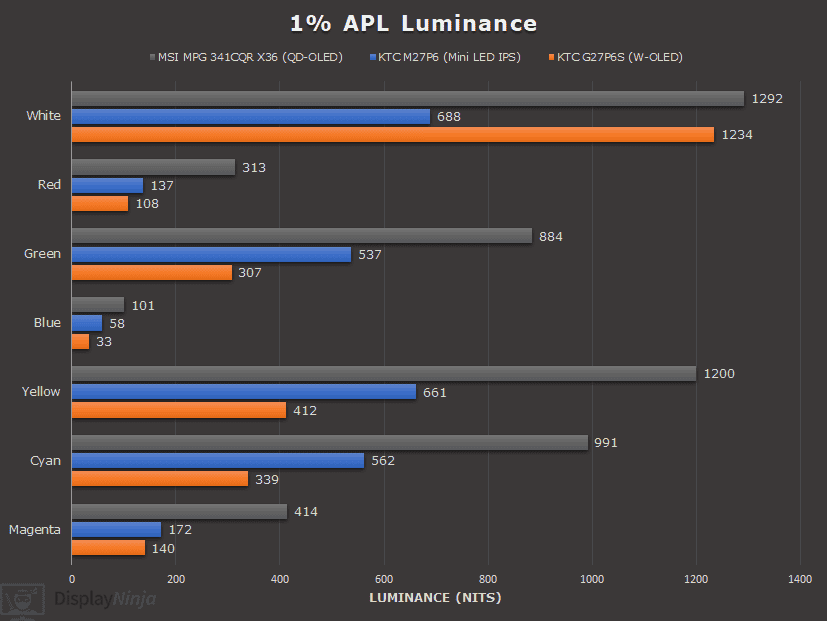
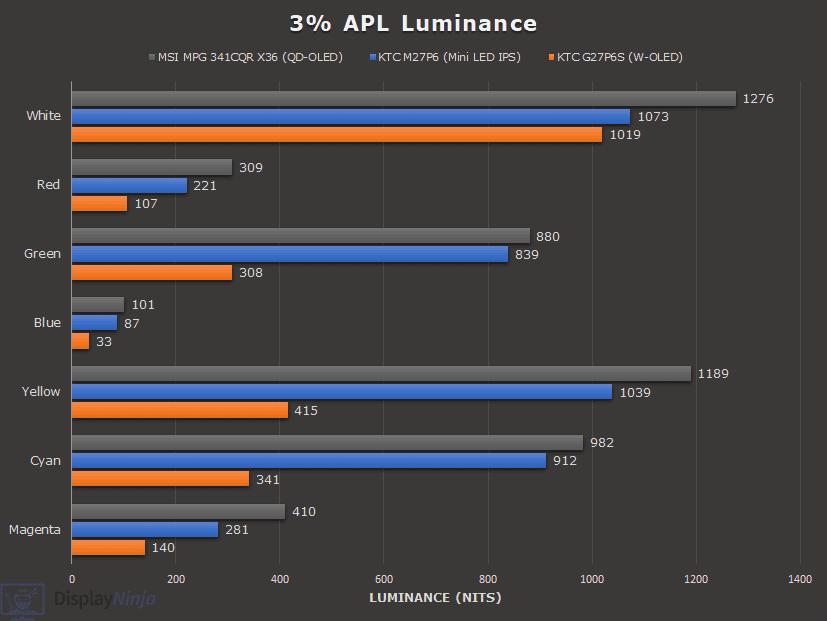
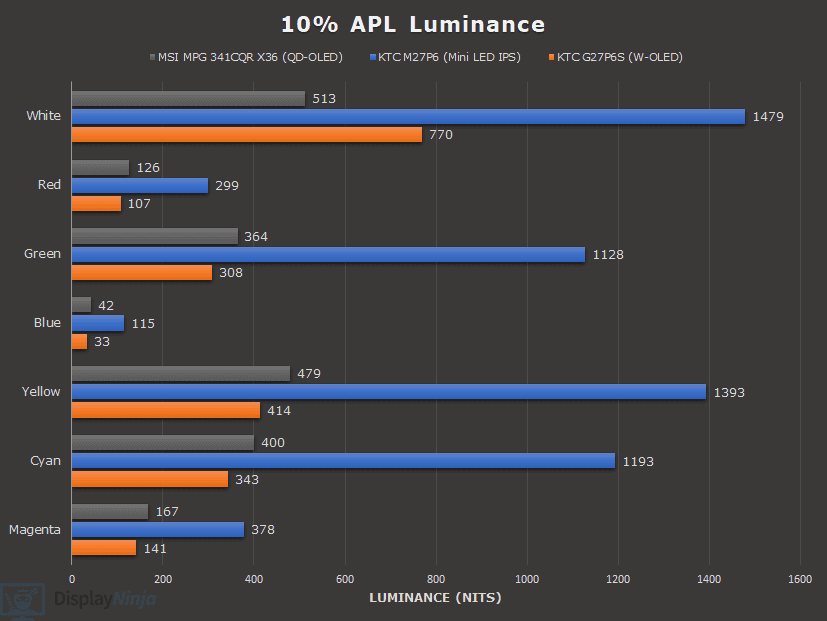
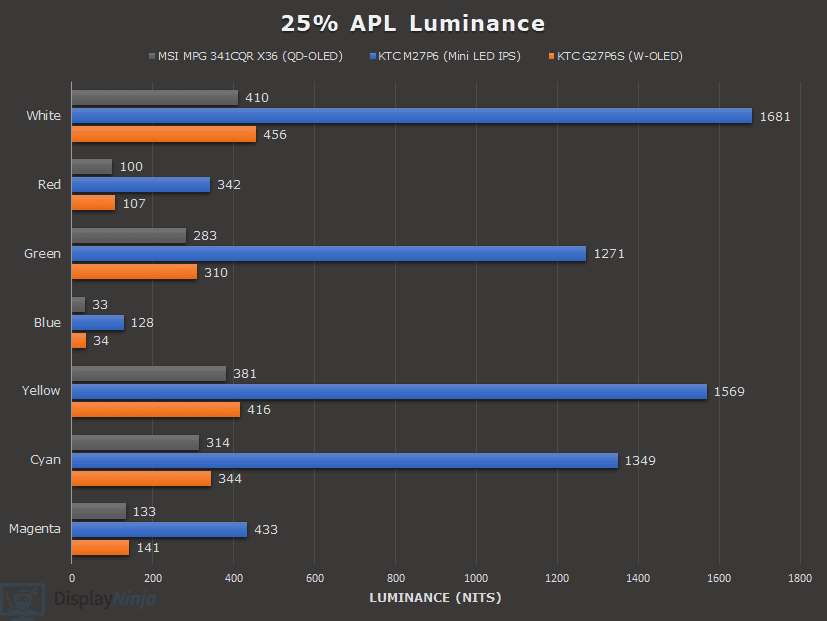
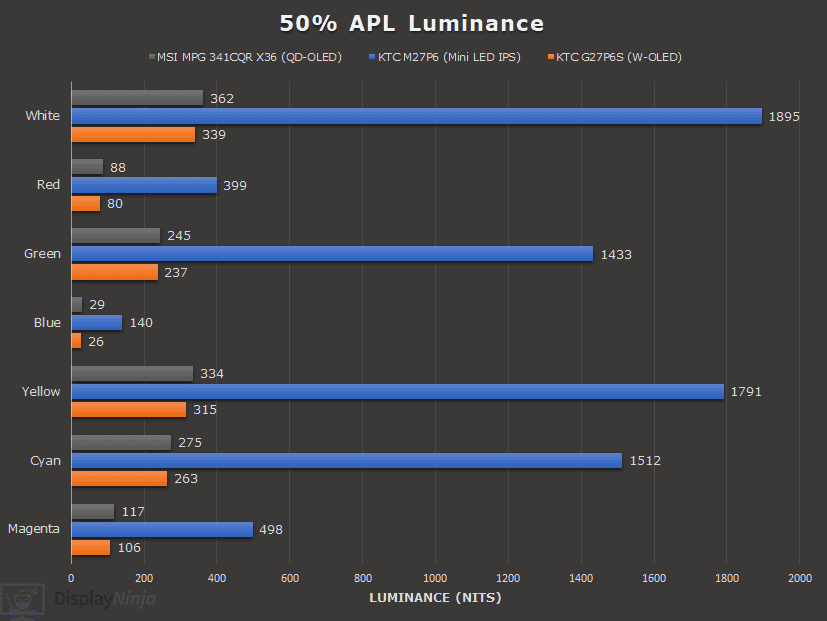
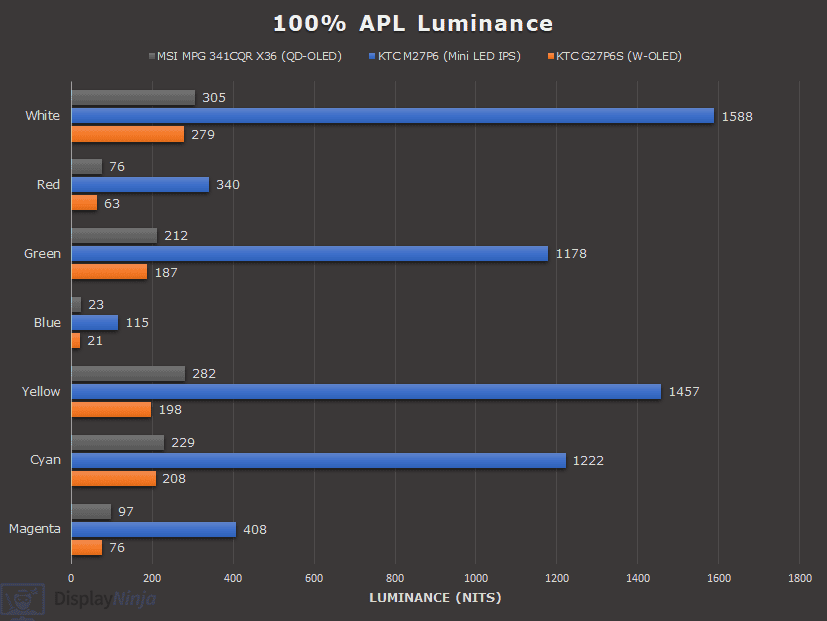
Mini LED monitors have significantly higher brightness for large APLs, but they have their own drawbacks as well, such as FALD blooming in certain scenes and they’re not as good at displaying SDR content with improved contrast.
MSI MPG 341CQR QD-OLED X36 Best Image Settings
For saturated colors:
Mode: User
For accurate colors in Windows:
Mode: sRGB
DisplayHDR: EOTF Boost
Ultra Low Power: Off
Performance
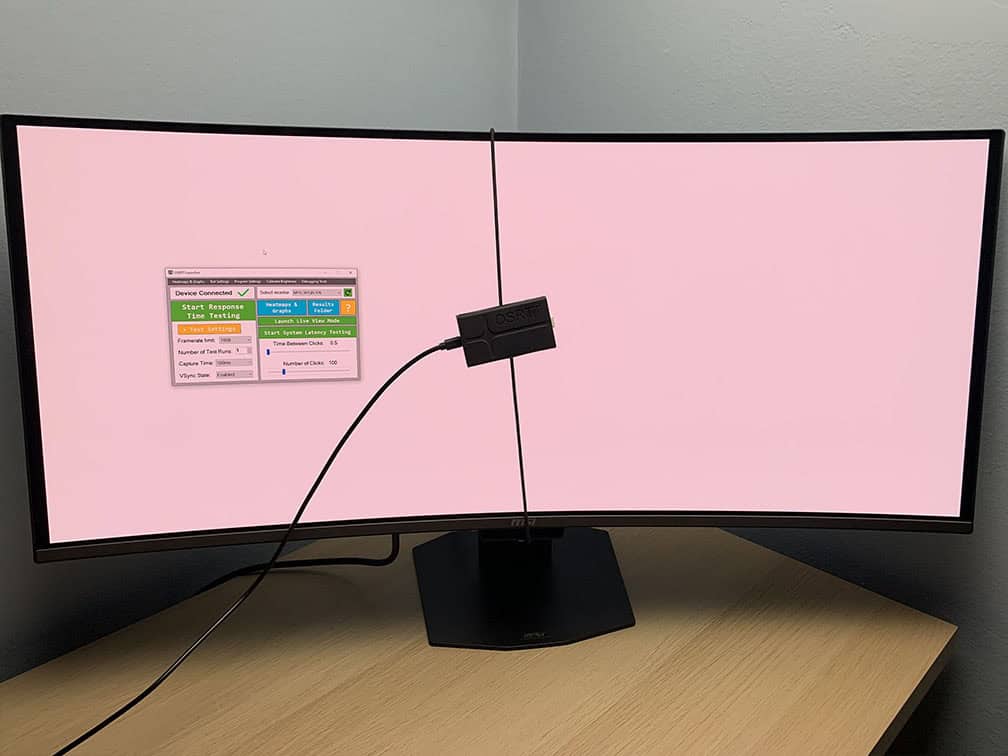
The MSI MPG 341CQR QD-OLED X36 has a maximum refresh rate of 360Hz, delivering exceptional motion clarity and responsiveness.
Response Time
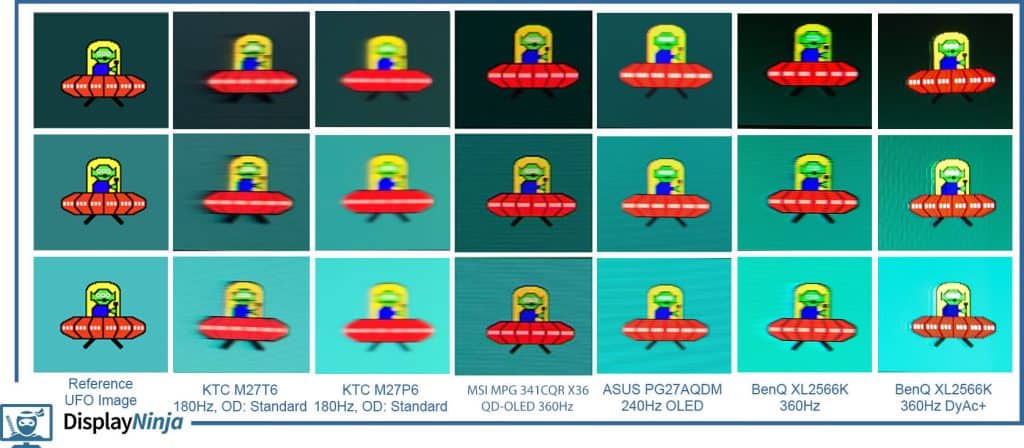
OLED panels have virtually instantaneous pixel response times, so there’s no ghosting behind fast-moving objects, no matter the refresh rate.
For latency and response time testing, we’re using OSRTT. Before the tests, the monitor was calibrated and warmed up.
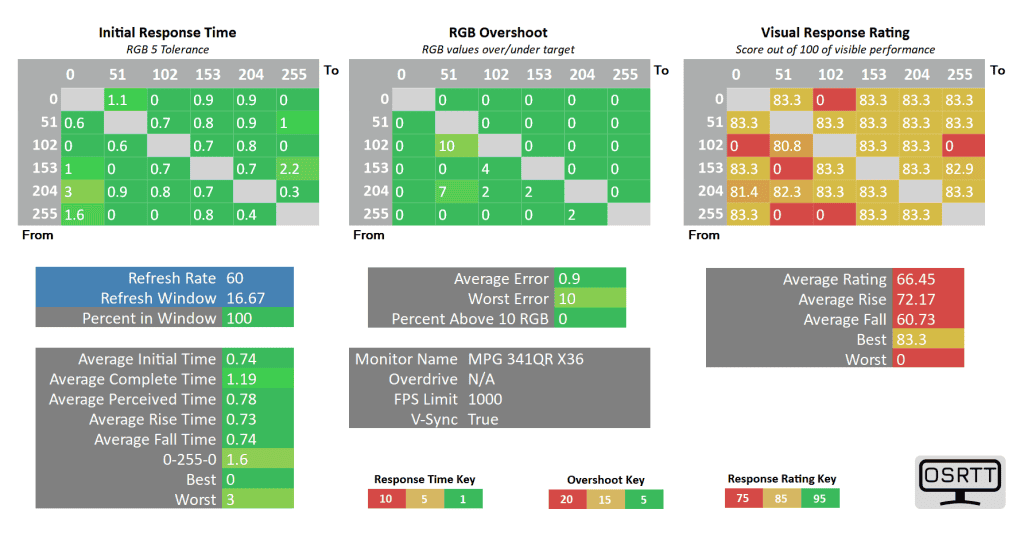
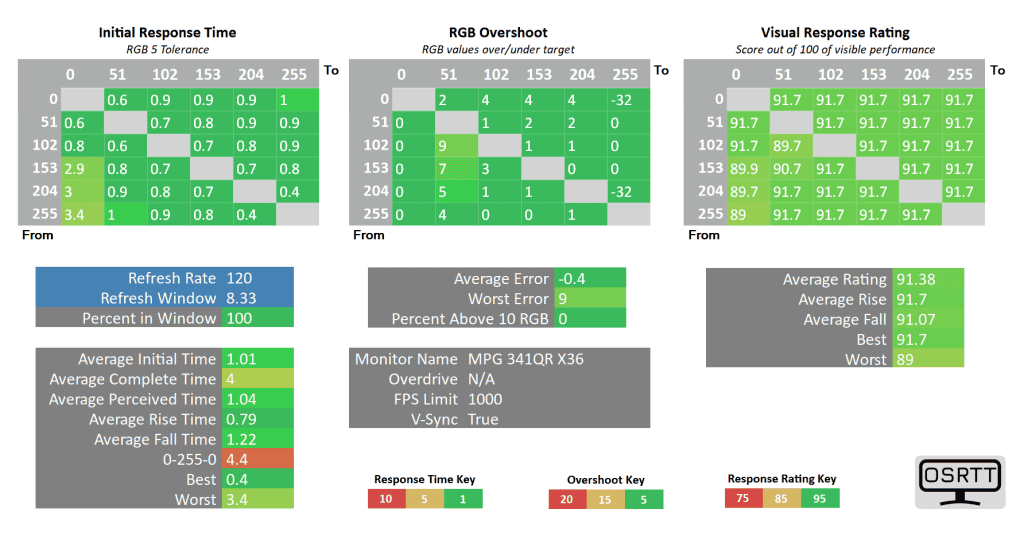
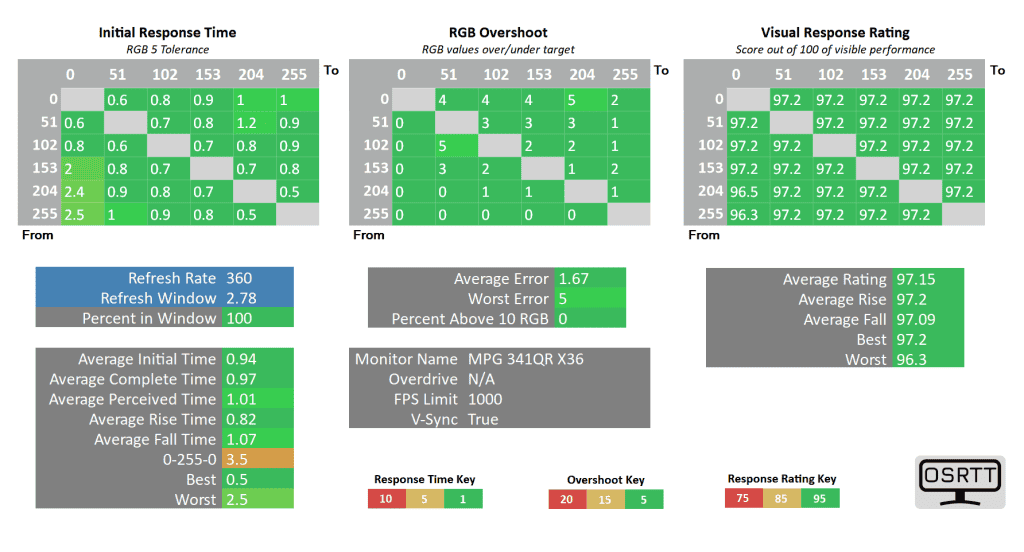
There are some slower transitions and overshoot present in the charts, but this is only due to the limitation of the OSRTT measuring device.
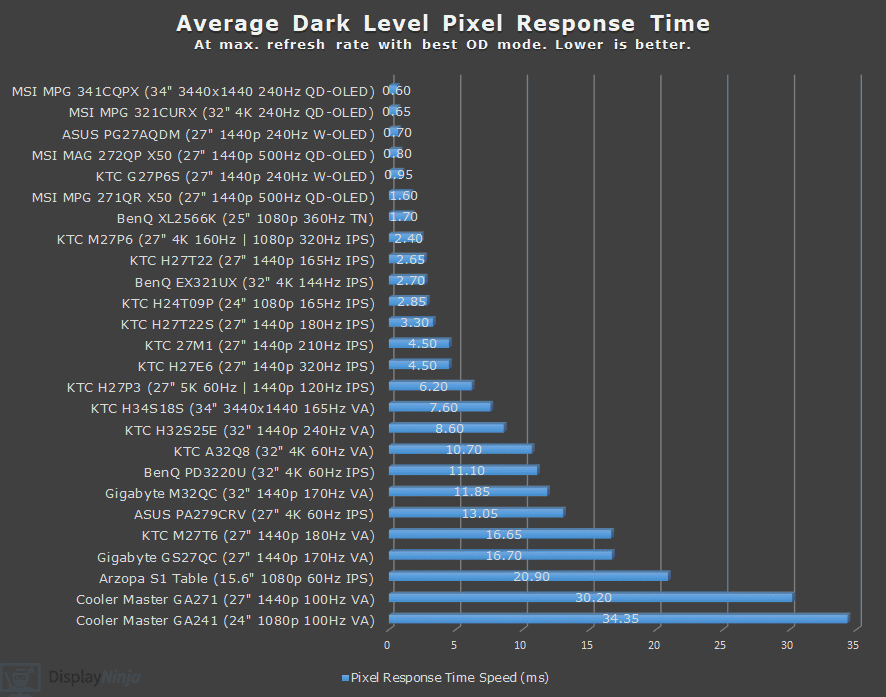
For Blur Busters’ UFO ghosting test, we used 960 Pixels Per Sec, shutter speed set to 1/4 of the refresh rate with fixed focus, ISO and color temperature (6500K).
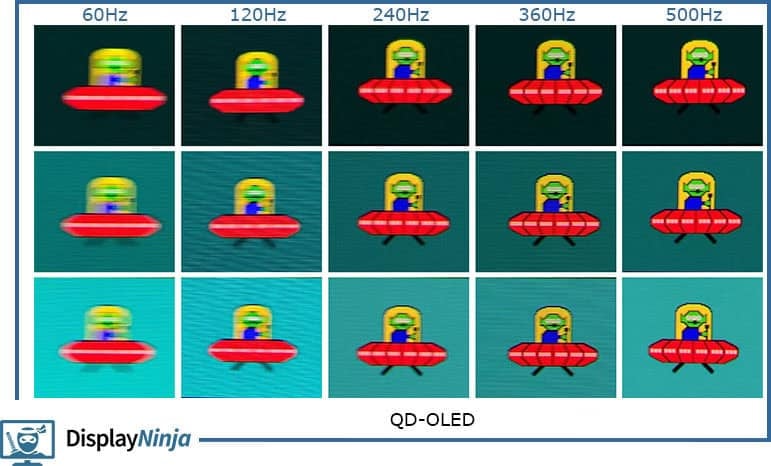
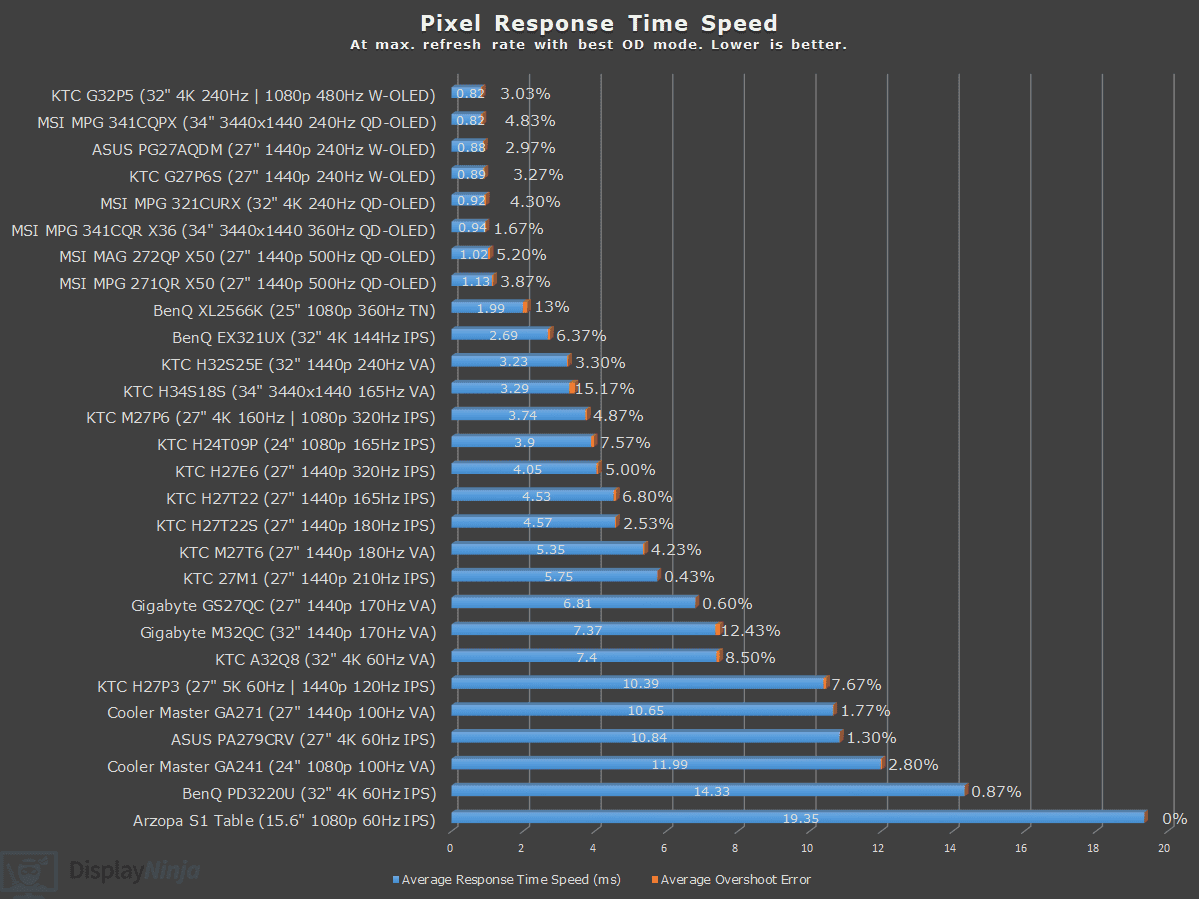
And here’s a comparison to several other monitors we tested.
Motion Blur Reduction
The MSI MPG 341CQR QD-OLED X36 supports BFI (Black Frame Insertion) via its MPRT feature. It reduces the maximum brightness to 158-nits since it basically displays half the frames as black in order to reduce perceived motion blur at lower frame rates.
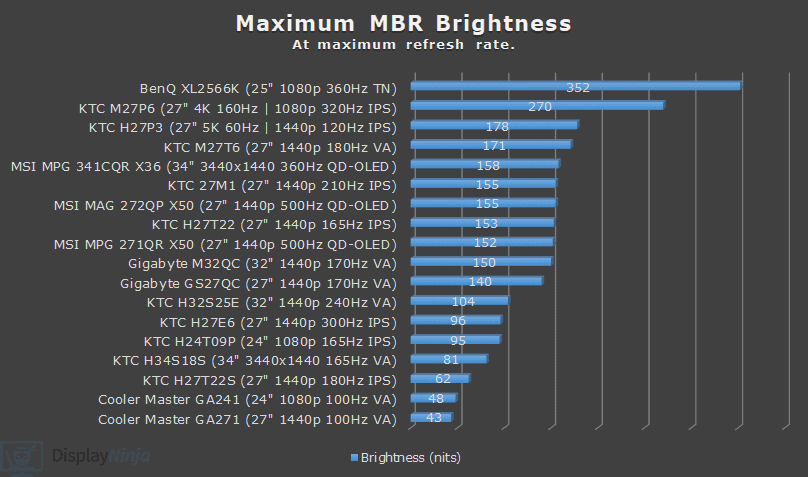
If you enable MPRT at 360Hz, you’ll need to manually cap the in-game frame rate at 180 FPS for optimal performance.
At 180 FPS BFI, you get the same motion clarity as native 360Hz (though with slightly higher input latency), which can be useful in fast-paced games where your system can’t exceed 180FPS.
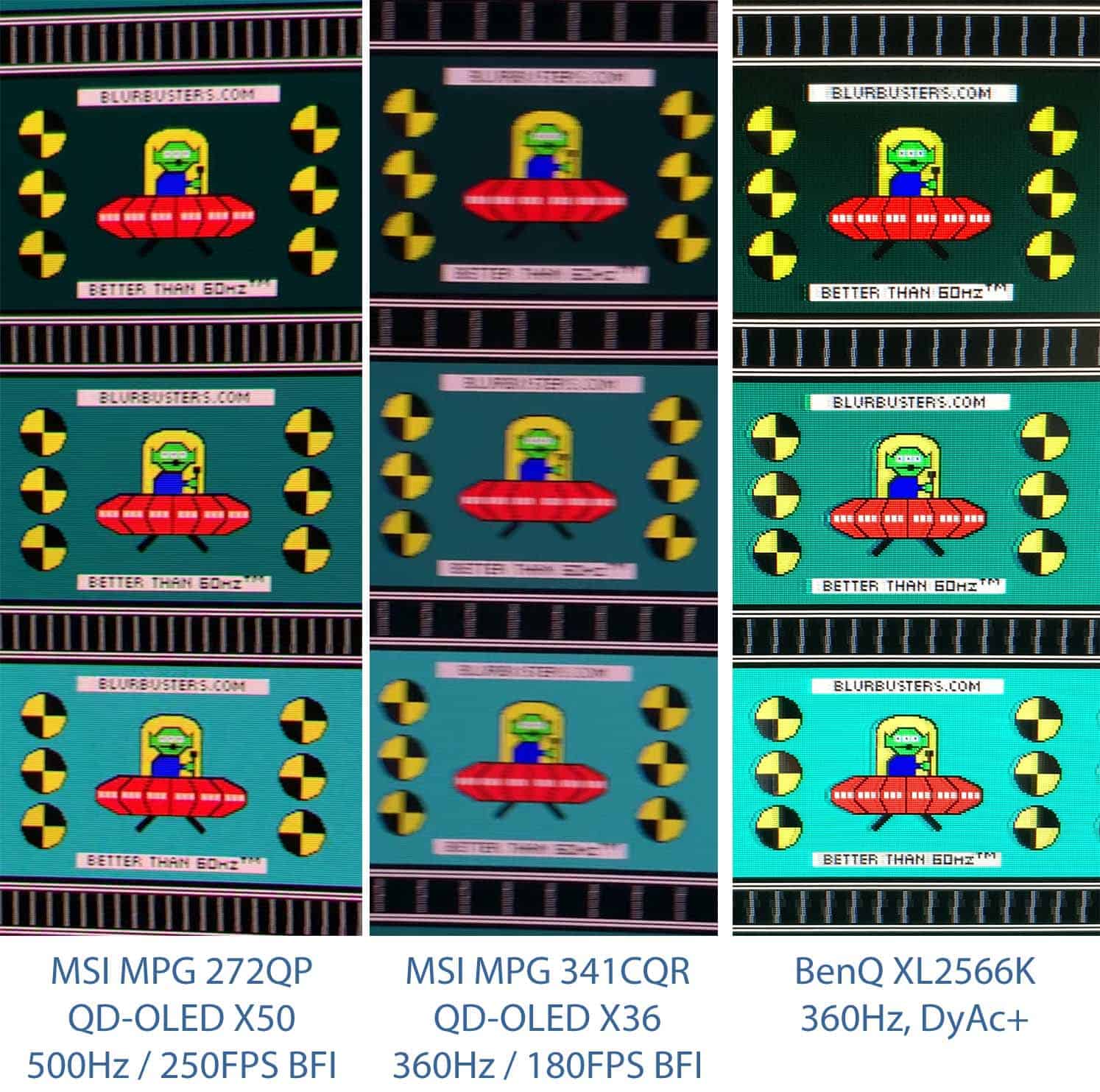
Keep in mind that MPRT cannot be used simultaneously with VRR (variable refresh rate).
Variable Refresh Rate
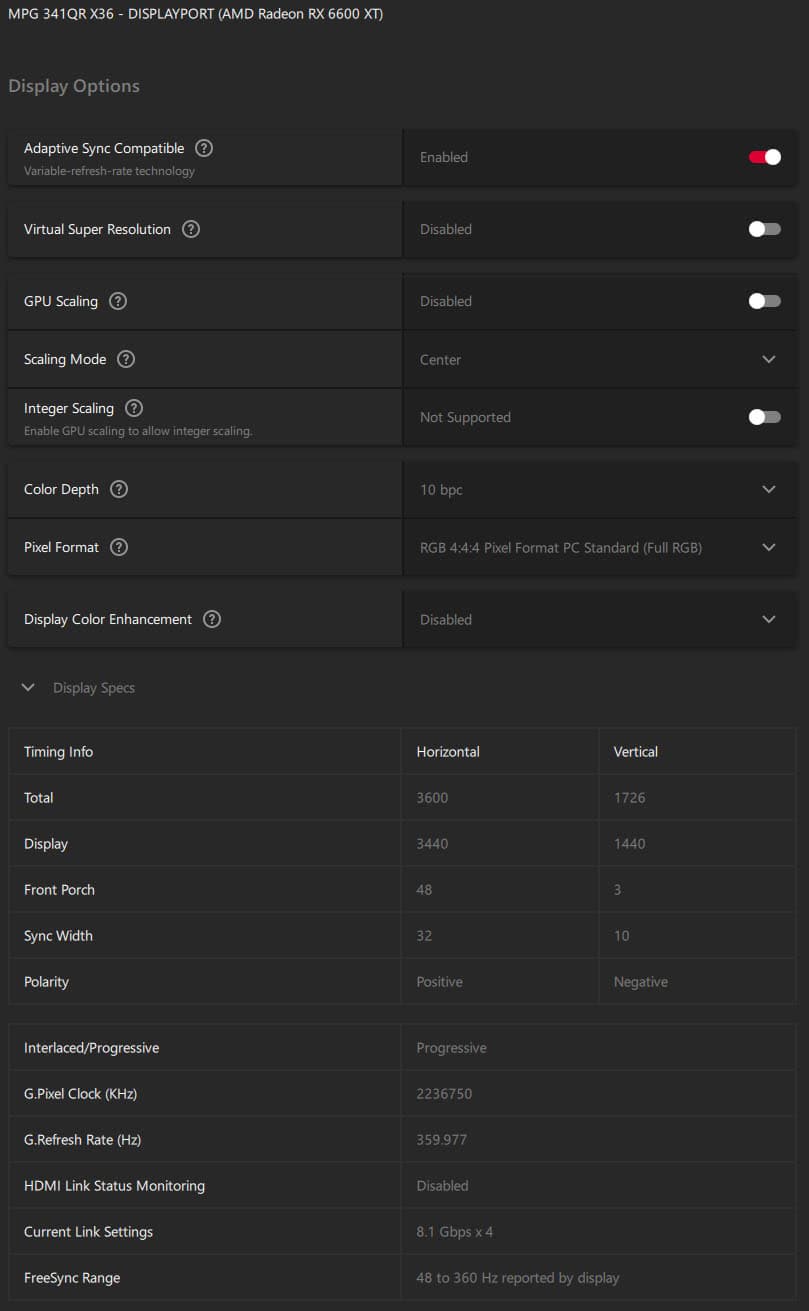
The monitor supports variable refresh rates via HDMI 2.1 VRR but has not yet been certified by NVIDIA as G-SYNC Compatible or by AMD as FreeSync Premium (Pro).
Regardless, VRR works with all graphics cards that support it for tear-free gameplay up to 360FPS with a 48-360Hz dynamic range.
However, as it’s the case with all OLED monitors, you might notice some VRR brightness flickering in games with fluctuating frame rates (mostly in darker scenes, loading screens and in-game menus).
This can be simply ‘fixed’ by disabling VRR in affected games, which isn’t much of a drawback considering that screen tearing is not that noticeable at 360Hz.
Latency
Here’s a look at display latency test results.
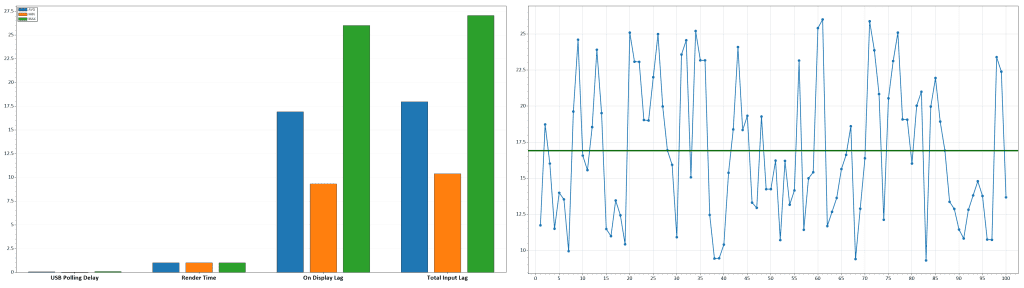
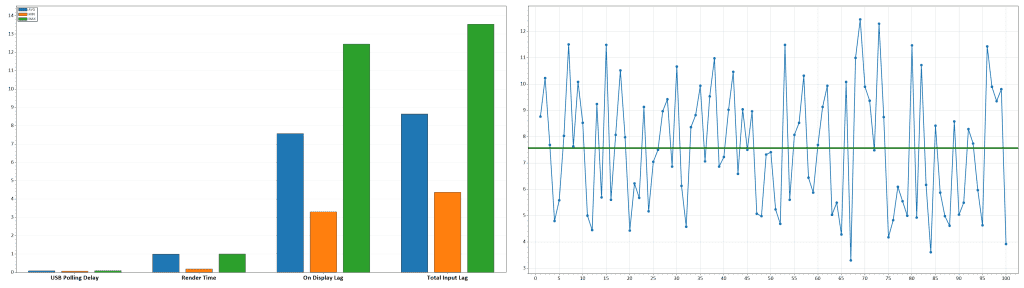
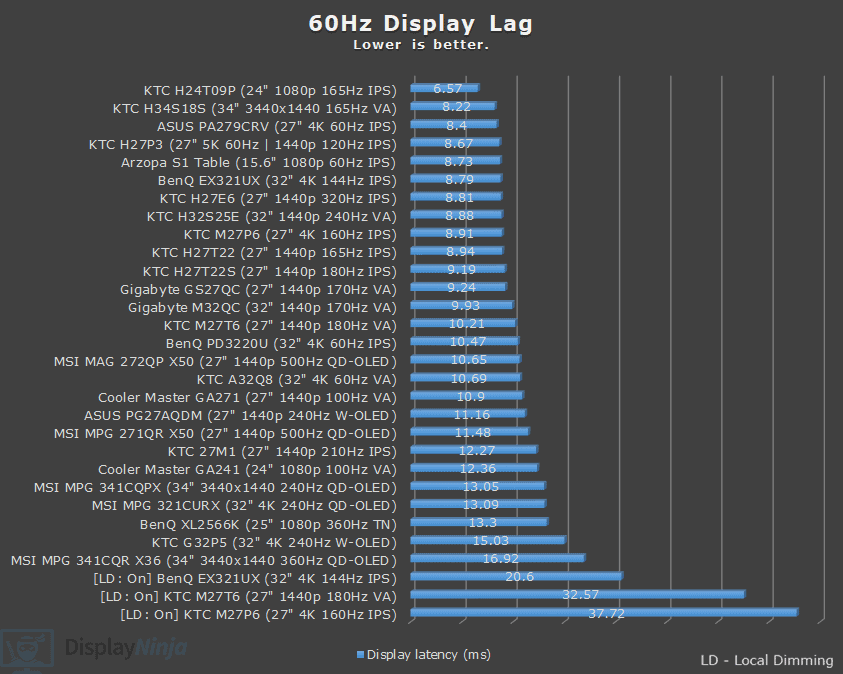
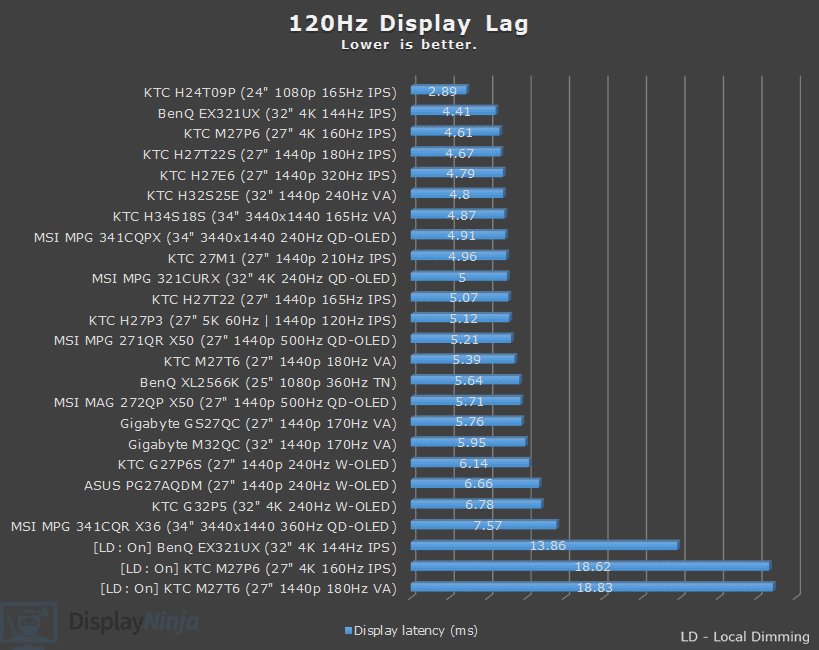
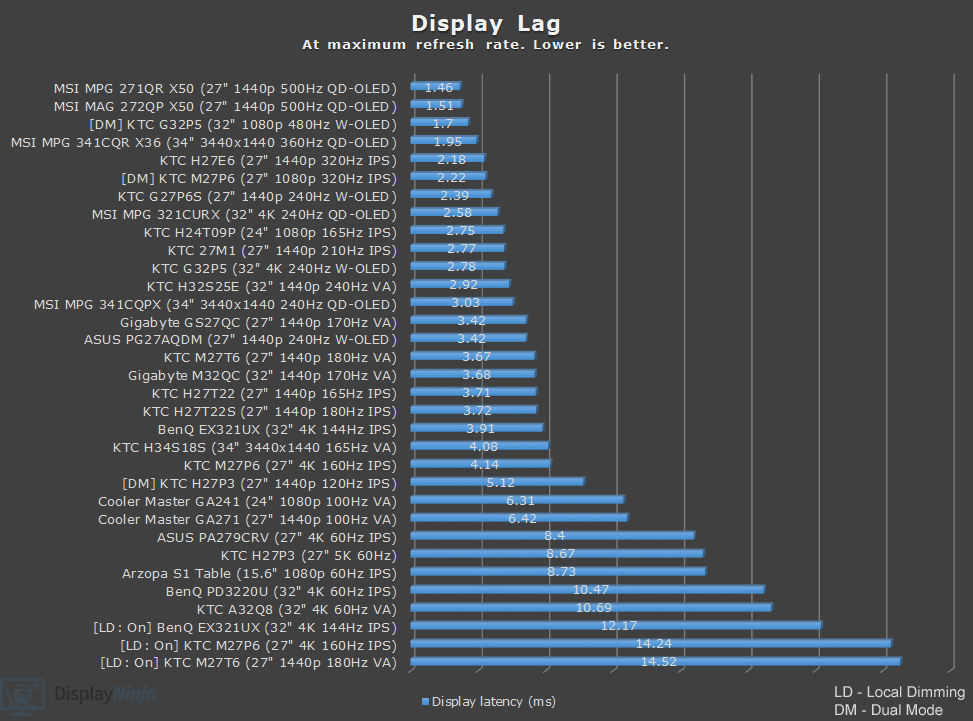
We measured low display latency of only 1.95ms at 360Hz and 7.57ms at 120Hz. Display latency at 60Hz was a bit higher at 16.92ms, slightly exceeding the 16.67ms refresh rate cycle, but there’s no perceptible delay between your actions and the result on the screen.
As this is an early sample, we believe this will be a bit improved with newer firmware.
Uniformity & Quality Control
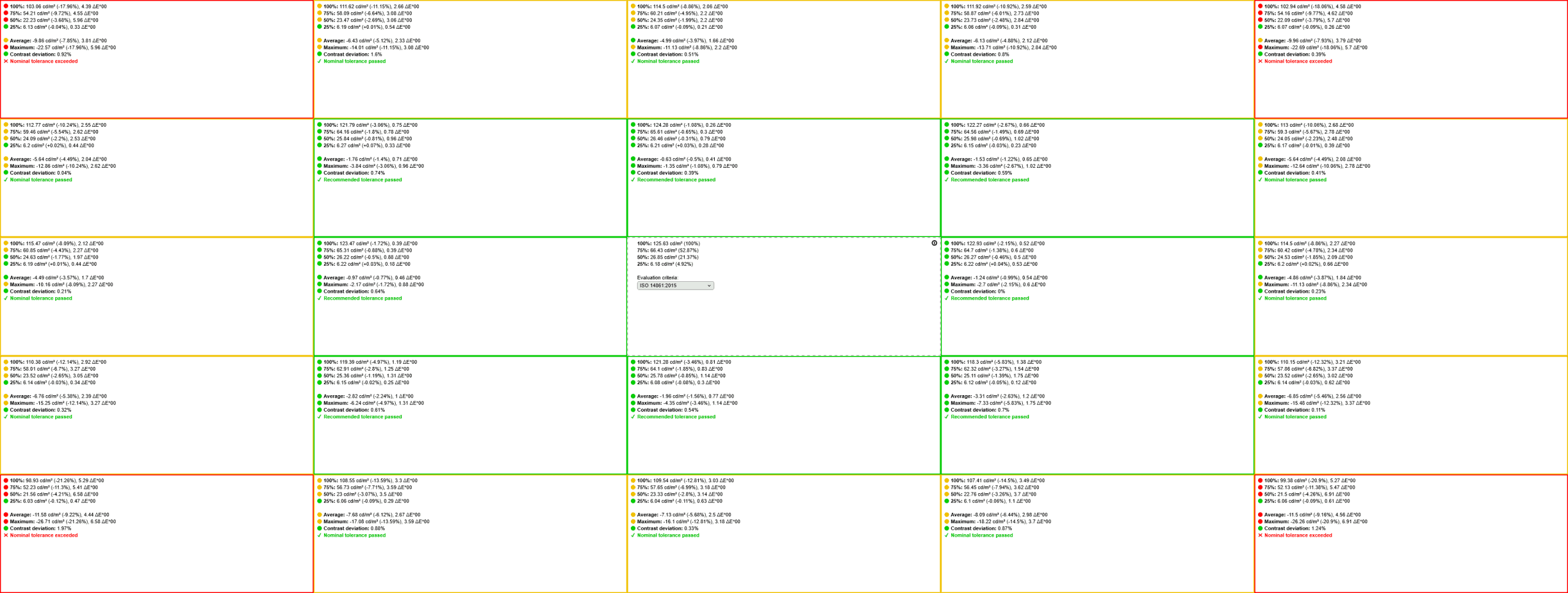
Moving on, the MSI MPG 341CQR X36 has decent image uniformity. The corners of the screen have up to 20% lower brightness on 100% white, but this wasn’t noticeable during everyday use.
As it’s the case with all OLED panels though, there’s some minor vertical banding on solid dark-gray backgrounds, but it doesn’t affect typical usage. We weren’t able to capture this on camera.
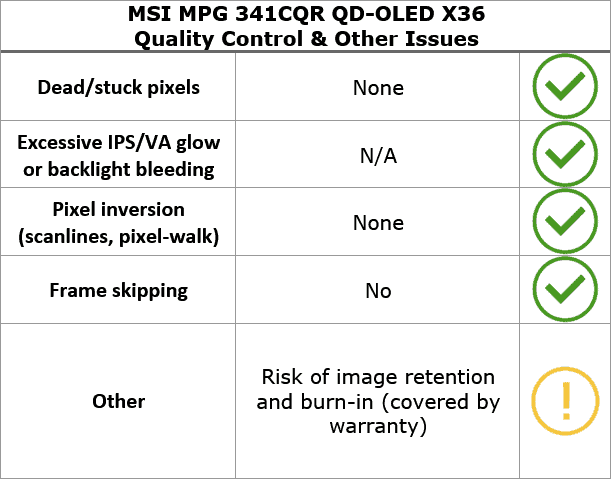
We didn’t find any stuck or dead pixels. OLED panels don’t suffer from IPS/VA glow or backlight bleeding, and there were no other issues, such as frame skipping or pixel inversion.
Apart from the minor fluctuations in brightness due to the way OLED panels work (which is invisible to the human eye), the monitor is completely flicker-free.
There’s also a low-blue light filter mode that reduces the color temperature down to 3956K for a more comfortable viewing experience before bedtime.
Features
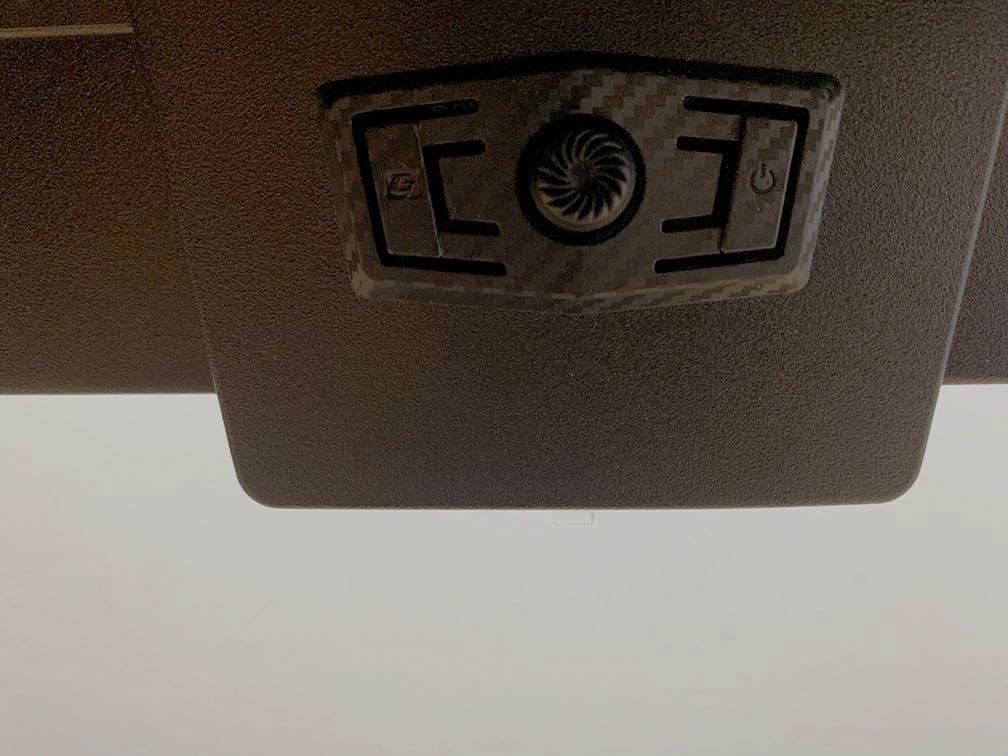
Behind the bottom bezel of the screen, there’s a directional joystick for quick and easy navigation through the OSD menu. There’s also a dedicated power button, an additional ‘G key’ button for shortcuts and a power LED indicator on the chin that houses the built-in sensor.
While the monitor is on, the power LED is white (the LED indicator can be disabled in the OSD menu) and blinks orange while the Panel Protect process is active.
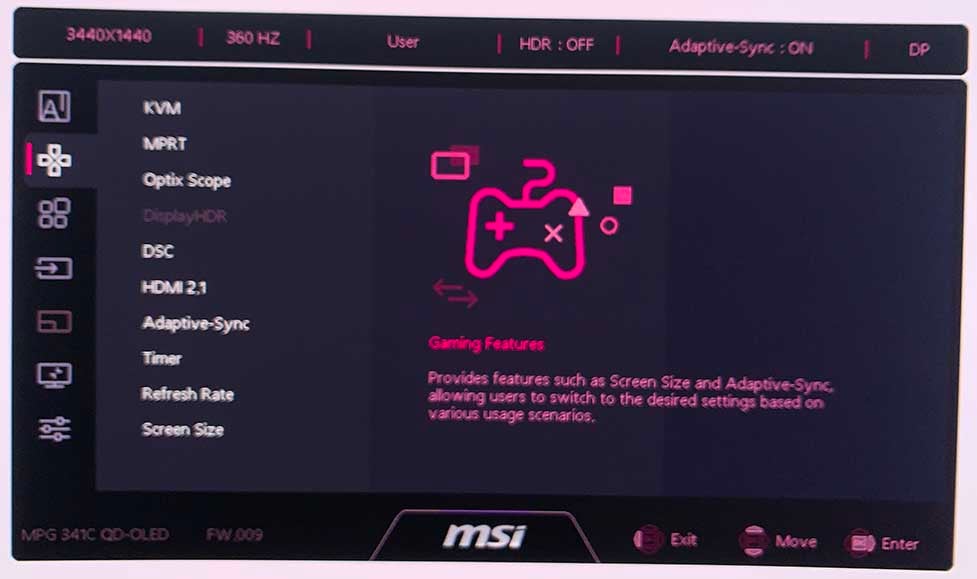
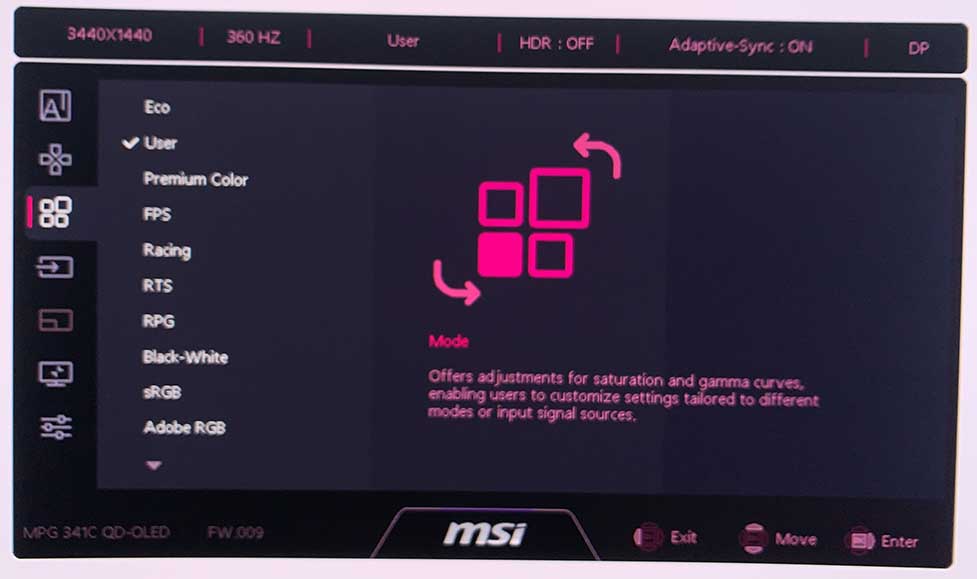
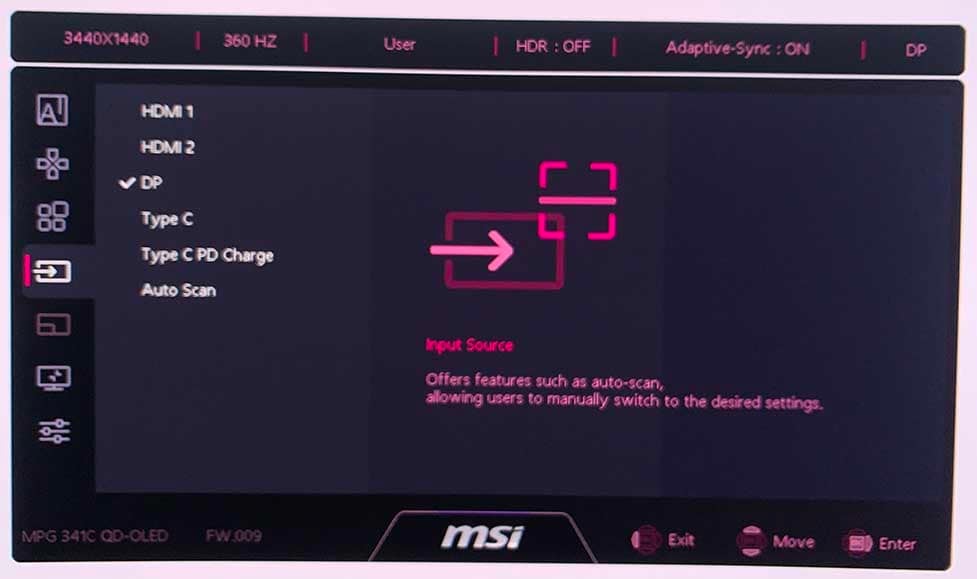
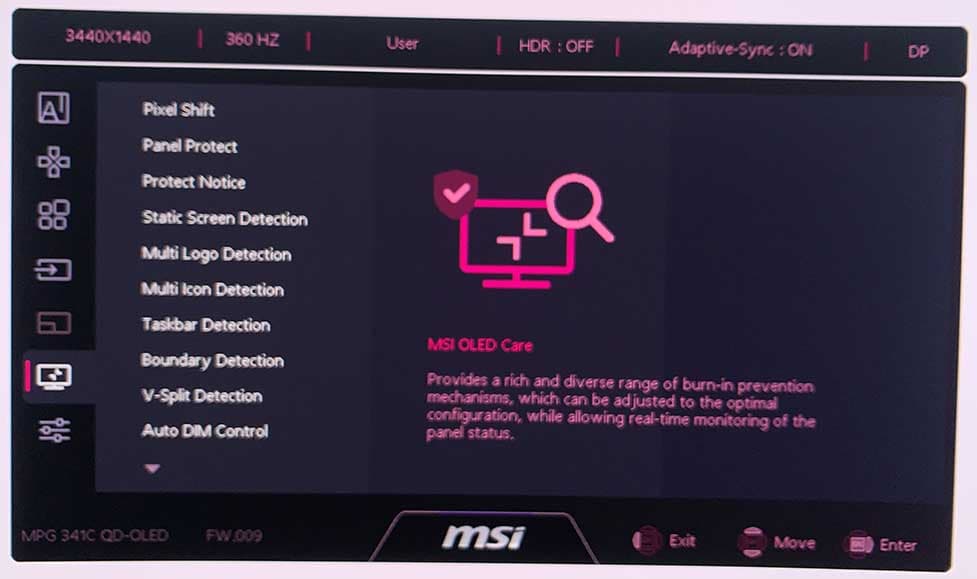
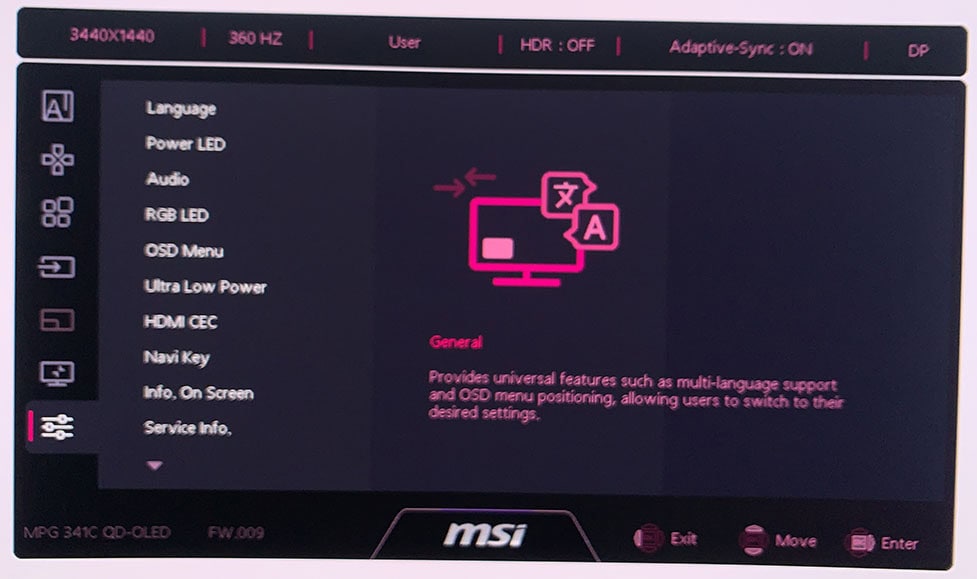
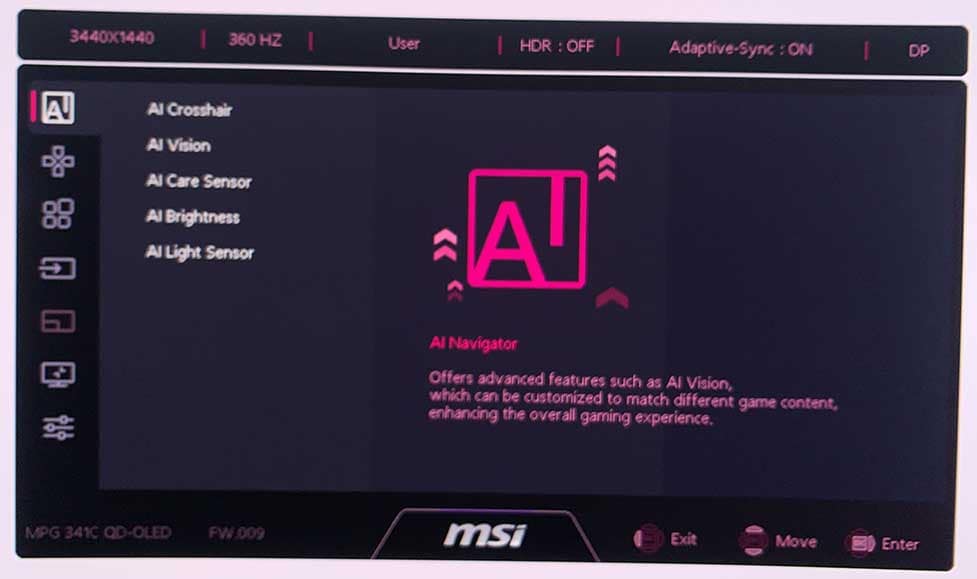
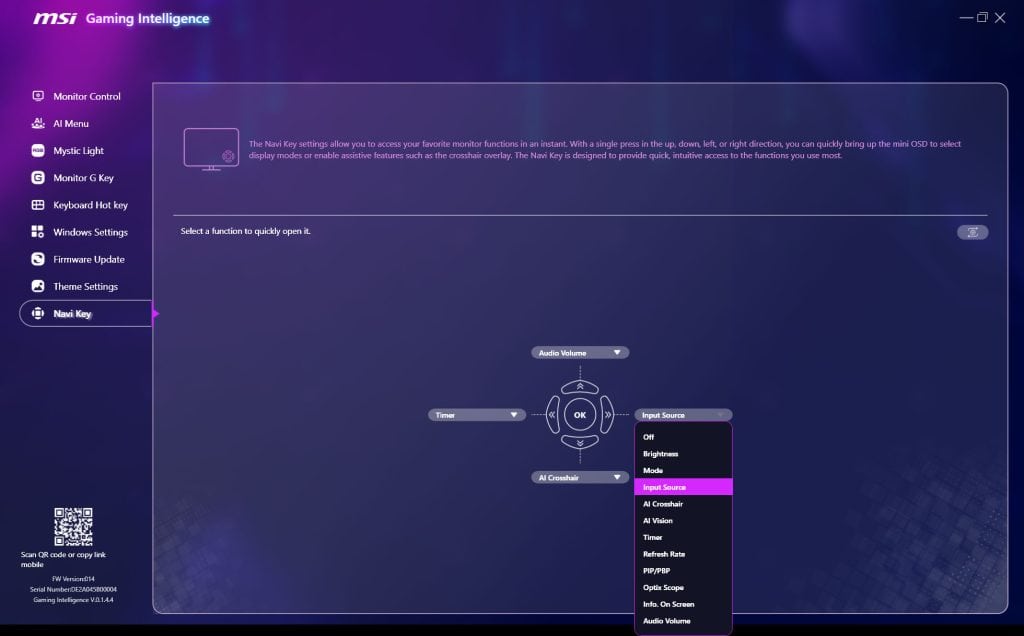
Moving the joystick up, down, left and right summons a quick menu for certain shortcuts, which can be changed to the following options: Brightness, Mode, Input Source, AI Crosshair, AI Vision, Timer, Refresh Rate, PiP/PbP, Optix Scope, Info. On Screen and Audio Volume.
The G key can be used to open the MSI Gaming Intelligence desktop application or assigned to AI Crosshair, Split Window, Split window – Action, Switch Input Source, PiP/PbP on/off or Optix Scope.
Besides the typical image adjustment tools (brightness, contrast, color temperature), the MSI MPG 341CQR also has some advanced settings, including DSC toggle, sharpness and automatic input detection. The OSD menu now has gamma and hue/saturation adjustments too.
Picture-in-Picture and Picture-by-Picture modes are supported as well.
When you connect the monitor to your PC via a USB cable, you can also use MSI’s Gaming Intelligence application to make all your OSD-related adjustments using your keyboard and mouse.
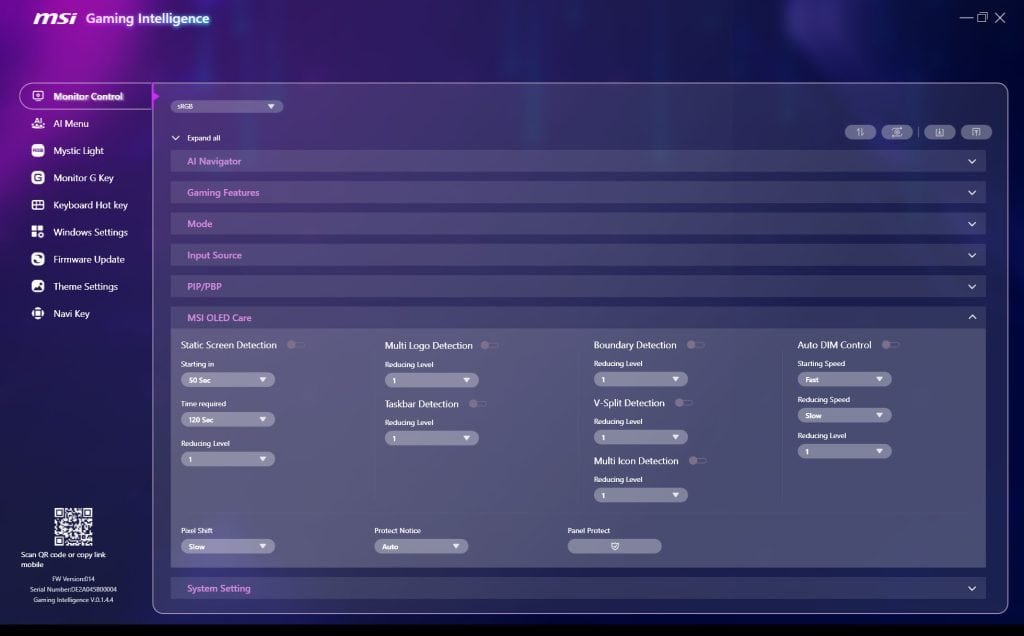
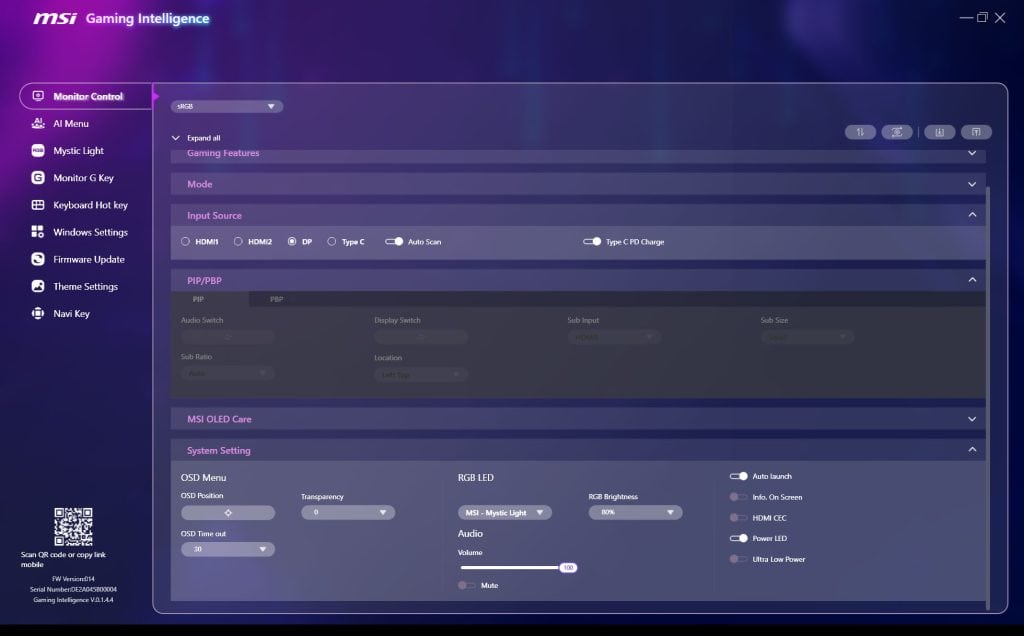
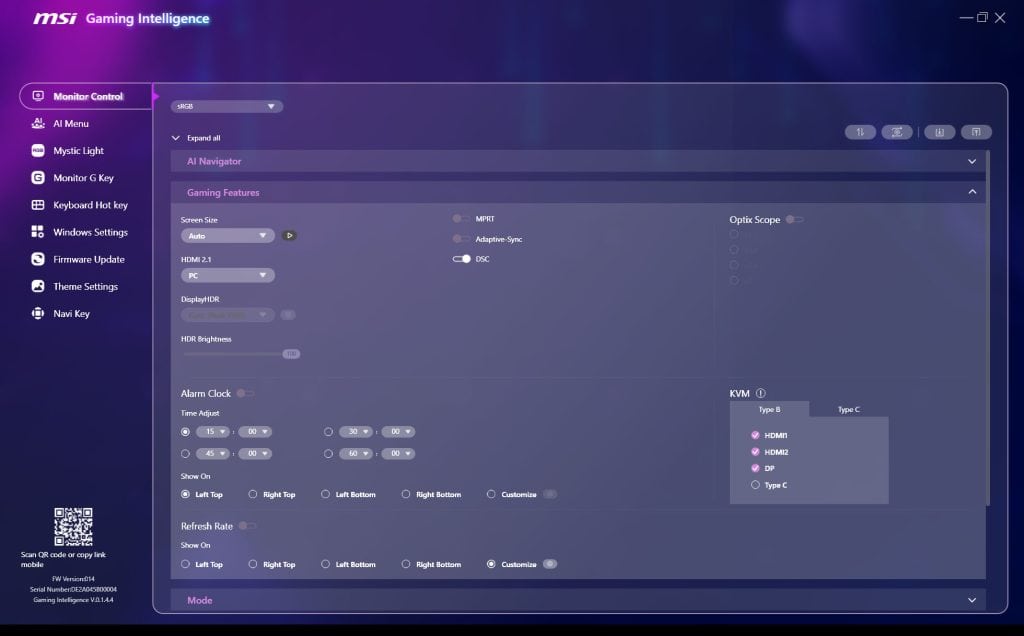
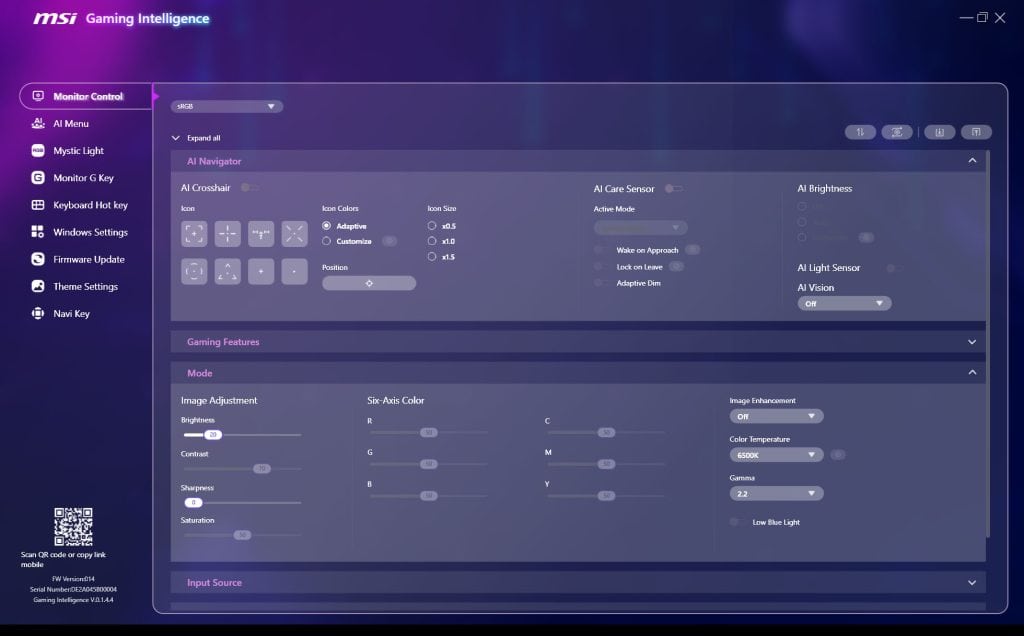
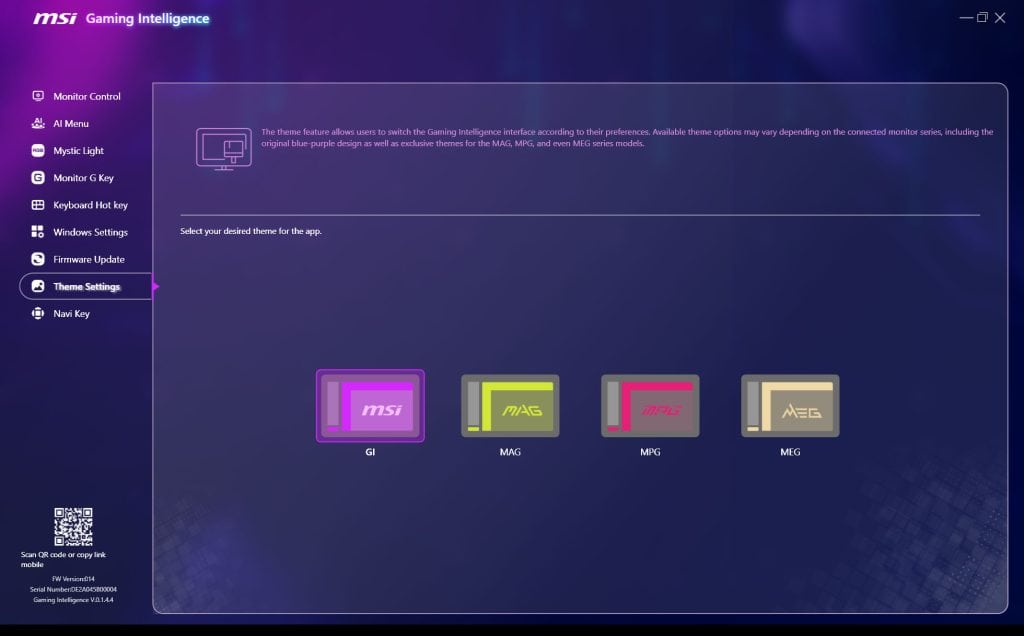
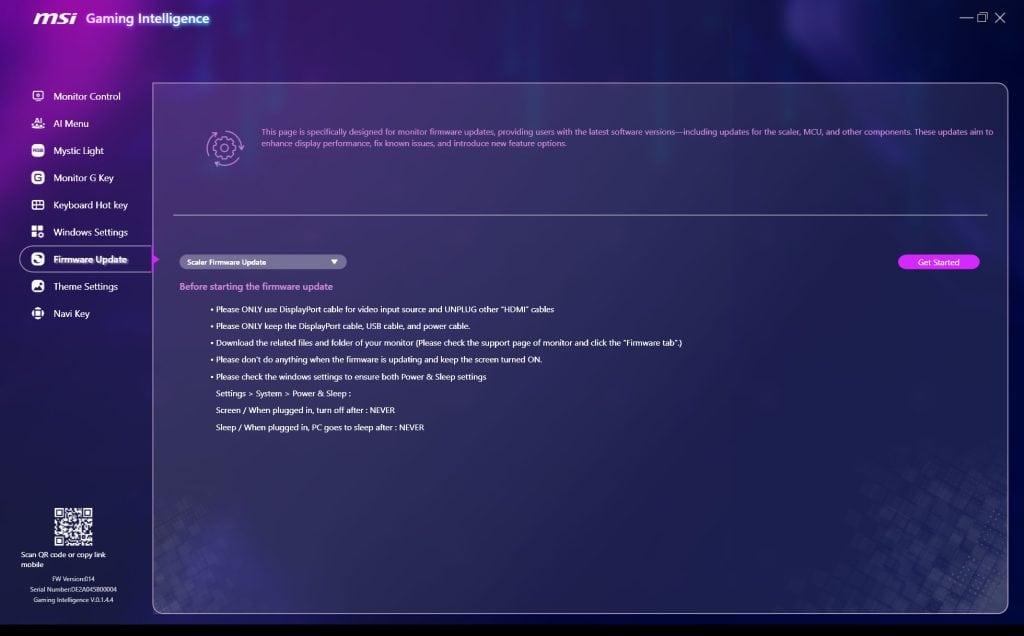
You can also have access to additional settings, such as assigning certain settings to specific applications, customizing RGB lighting, choosing what the ‘G key’ and navigation keys do, assigning keyboard shortcuts, some Windows settings, changing the theme and updating firmware.
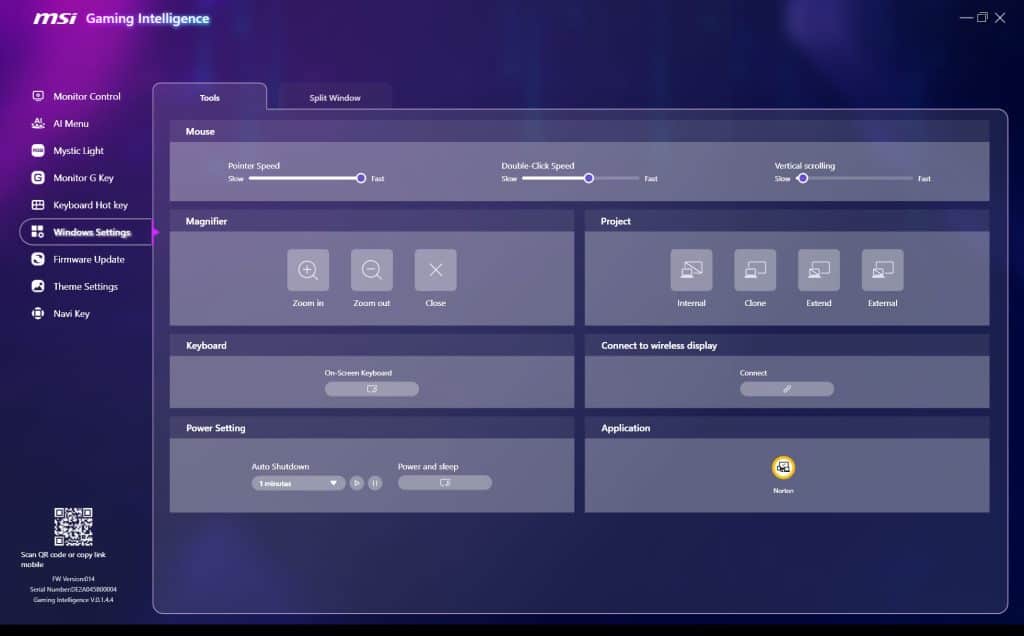
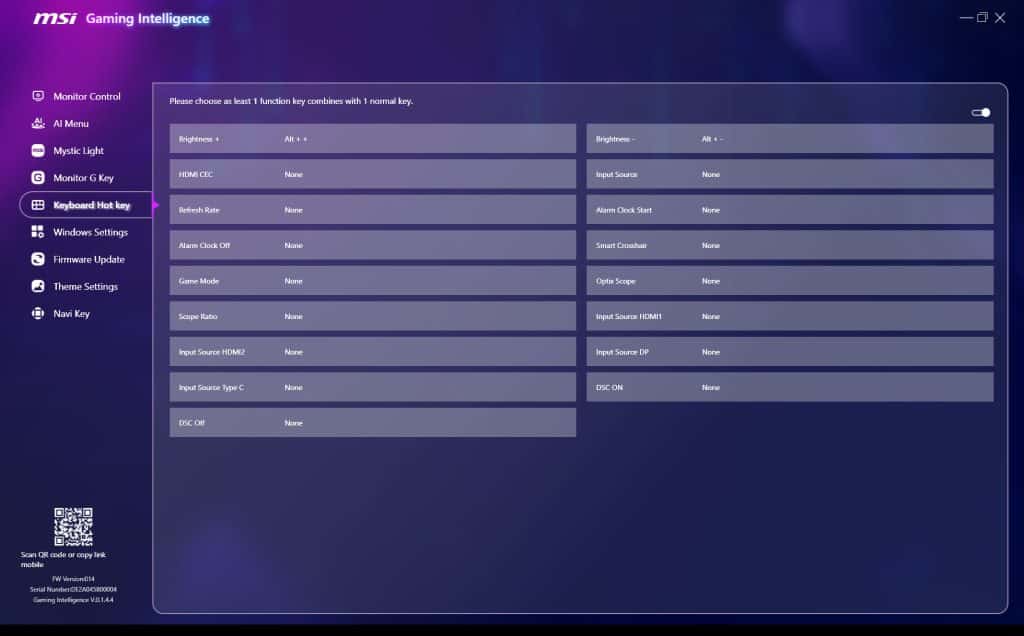
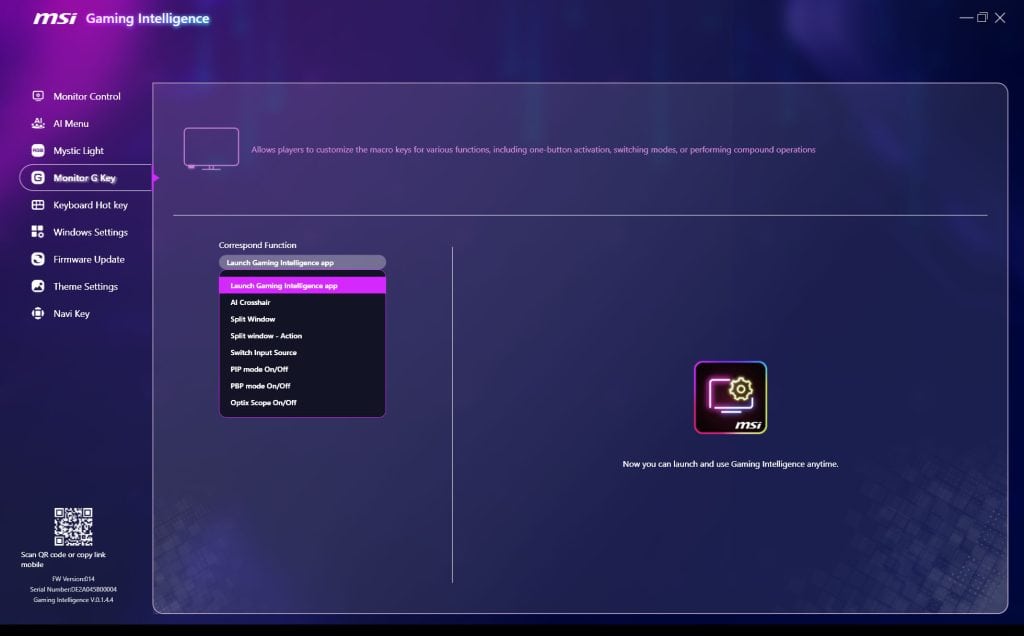
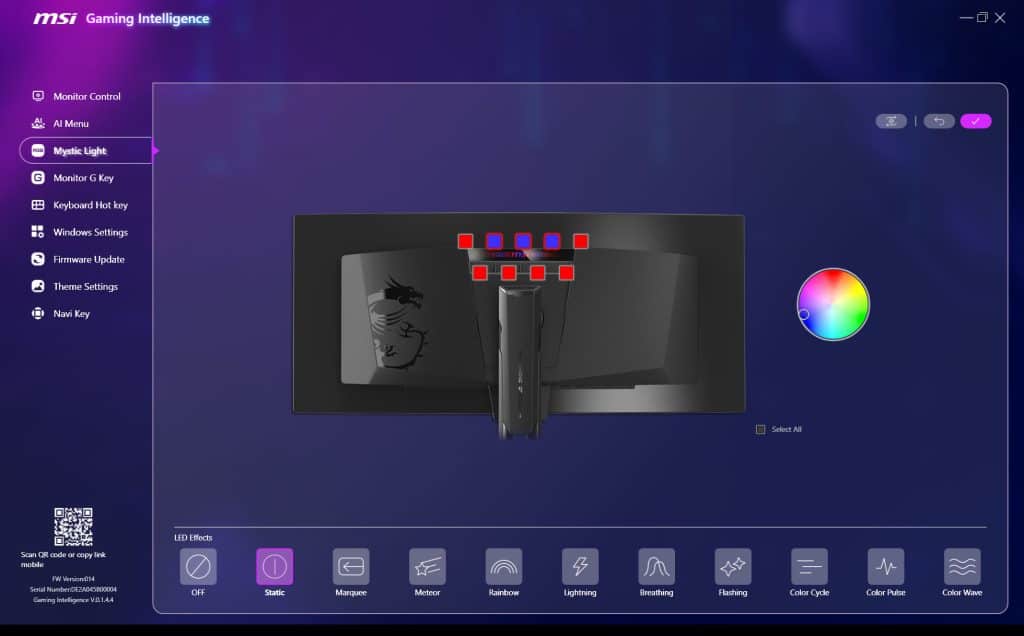
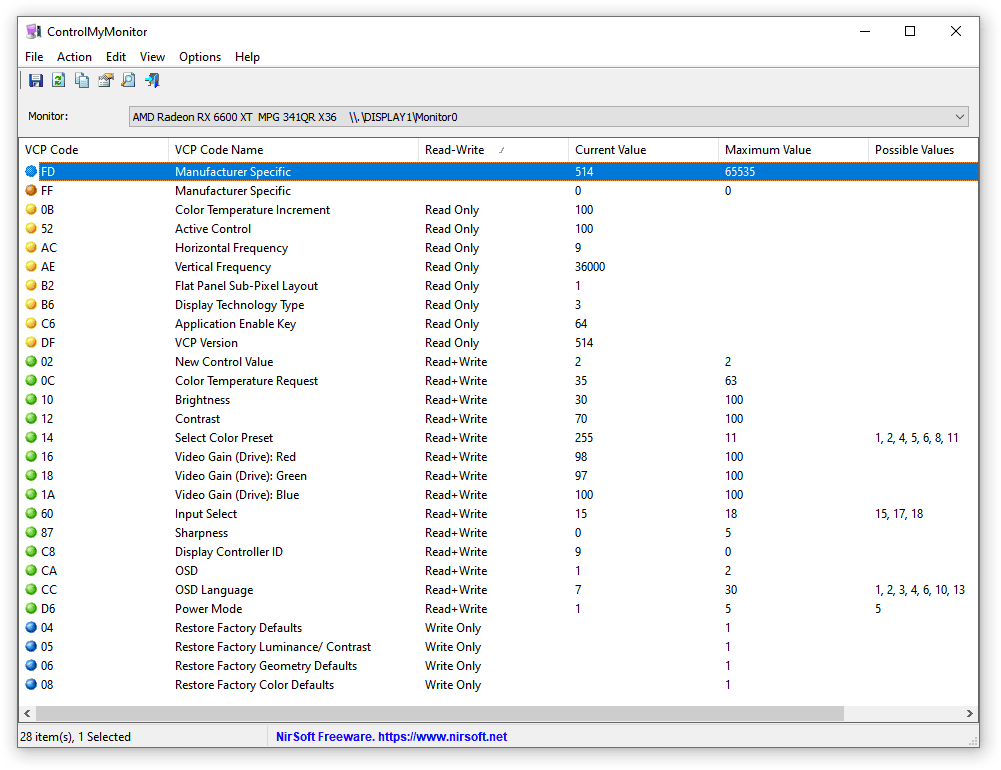
Here are the settings you can change using third-party apps, such as ControlMyMonitor.
Useful gaming features include:
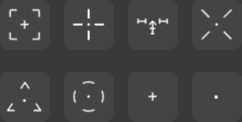
- AI Crosshair – fully customizable color or adaptive (changes color depending on the background). You can also change the position and size (x0.5, x1.0, x1.5)
- AI Vision – improves visibility in dark scenes without over-brightening the bright parts
- Optix Scope – zooms in on the area around your crosshair
- Screen Size – Auto, 4:3 (Forced), 16:9 (Forced), 21:9 (Forced), 1:1 (by pixel)
- On-Screen Timer
- Refresh Rate Tracker
Other settings include HDMI 2.1 for console or PC compatibility, OSD options (language, timeout, transparency and position), power LED indicator, audio, RGB lighting, and HDMI CEC, which allows the monitor to power on automatically when a console is turned on.
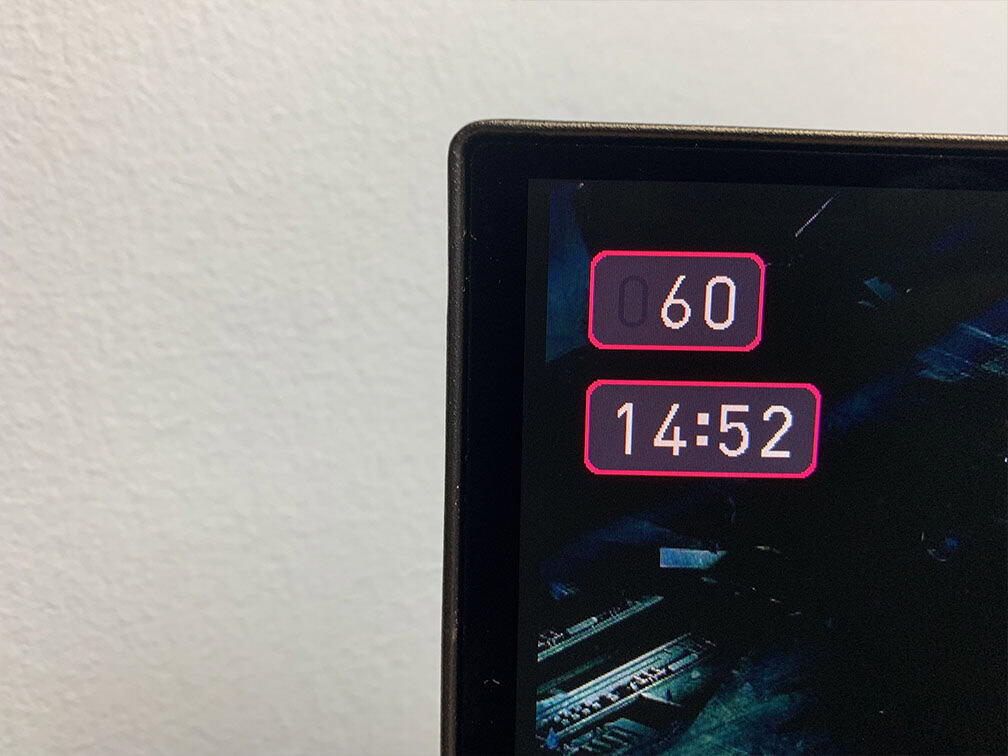
Additional options include USB-C Power Delivery charging up to 98W, Info On Screen (displays details like the current resolution and refresh rate), Ultra Low Power mode to reduce power consumption (we recommend disabling it for optimal image quality) and a factory reset option.
There’s also a built-in KVM functionality. When you connect two PCs to the MSI MPG 341CQR QD-OLED X36 monitor, you can effortlessly swap control between them by connecting your keyboard and mouse to the monitor.
Burn-in Prevention
The main downside of OLED panels is the risk of image retention and permanent burn-in. If bright, static elements are left on screen for extended periods, they can sometimes leave a permanently visible afterimage.
With sensible use, varied content, and MSI’s OLED Care features enabled, this is unlikely to be a problem in everyday use.
MSI even offers a 3-year warranty that covers burn-in.
Additionally, the MSI MPG 341CQR QD-OLED X36 has active cooling via its heatsink instead of using a cooling fan, which can be loud and fail over time.
You’ll find the following OLED care features in the OSD menu:
- Pixel Shift – occasionally moves the entire image by a few pixels (three frequency levels available, cannot be disabled)
- Panel Protect – refreshes the pixels after 4 hours of cumulative use (takes around 9 minutes)
- Panel Notice – Auto or Usage 24 hrs, panel notice pops up after 4 hours of cumulative use or after 24 hours if set to ‘Usage 24 hrs’
- Static Screen Detection – lowers the brightness after detecting that a static image remains on the screen
- Multi Logo Detection – lowers the brightness of static elements
- Taskbar Detection – lowers the brightness of the taskbar area
- Boundary Detection – lower the brightness when letters, pillars, etc. are detected
- V-Split Detection – lower the brightness along vertical lines
- Auto DIM Control – gradually lowers the brightness when static images are detected
AI Sensor
The MSI MPG 341CQR QD-OLED X36 also has an AI Sensor that can greatly help mitigate burn-in and image retention.
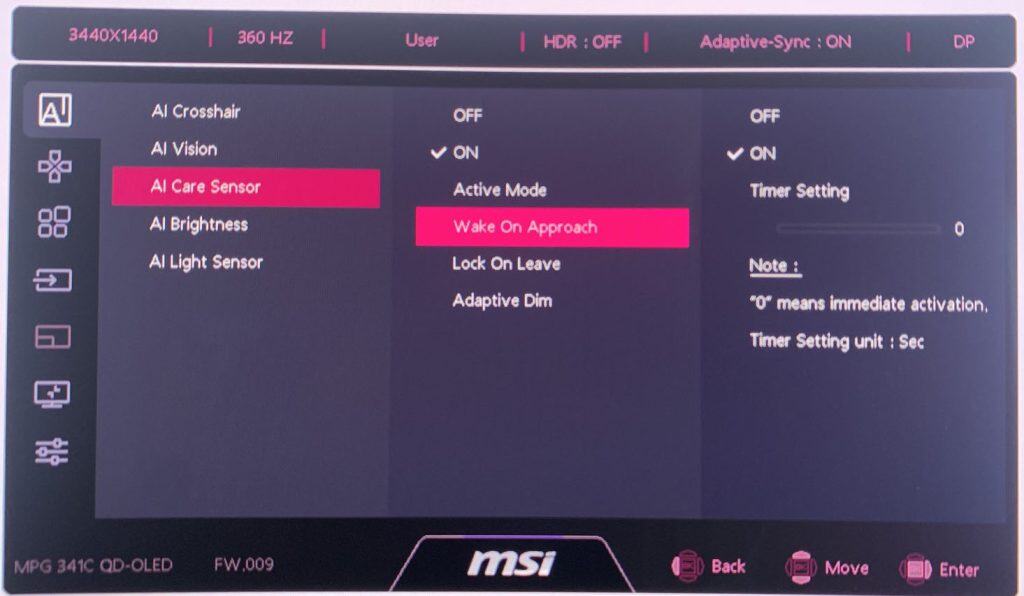
First, you’ll need to set the AI Care Sensor to ‘On’ and under the ‘Active Mode’ choose between ‘System’ or ‘Monitor’ mode. If you choose ‘System’, you’ll be able to adjust the sensor in Windows settings (requires Windows 11).
The Monitor Mode allows you to make all of the sensor adjustments in the OSD menu.
WoA (Wake on Approach) wakes the monitor when it detects a person in front of it (you can set it to immediately or after up to 30 seconds), while LoL (Lock on Leave) puts the monitor into standby when it no longer detects a person nearby (you can set the timer between 10 and 120 seconds).
The sensor can detect a user from up to 120cm and across a 75° wide area in front of the display.
There’s also the Adaptive Dim feature, which can dim the screen when it detects that the user has looked away.
The small CMOS camera sensor takes images every 0.2 seconds and processes them instantly on the monitor using an on-device AI chip. If privacy is a concern, you can rest easy knowing the images aren’t stored or uploaded anywhere.
Other AI Sensor settings include AI Brightness and AI Light Sensor, which can automatically adjust screen brightness and color temperature, respectively, according to ambient lighting.
Design & Connectivity
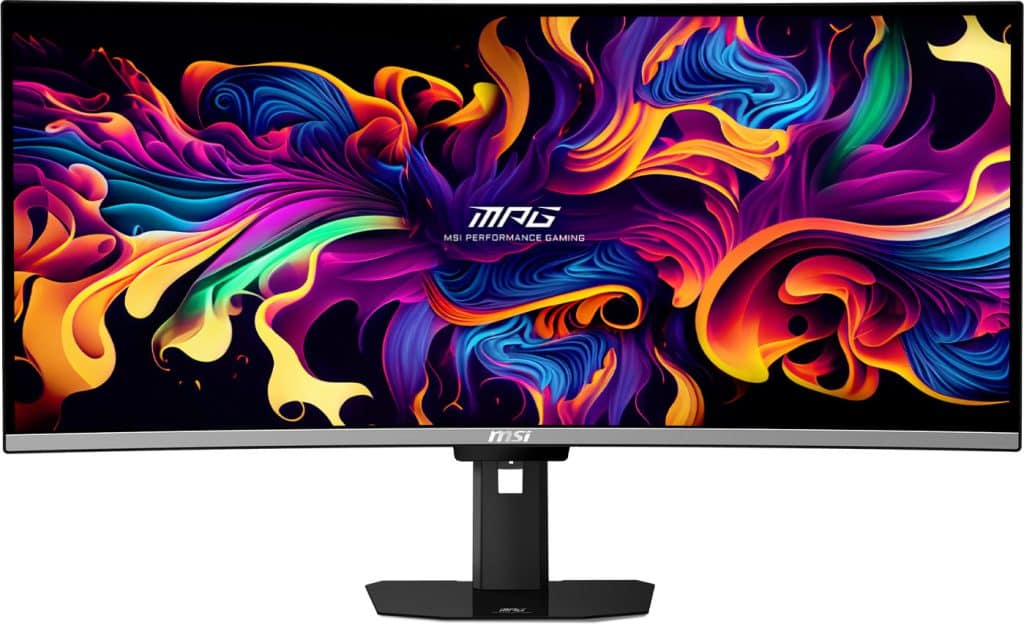
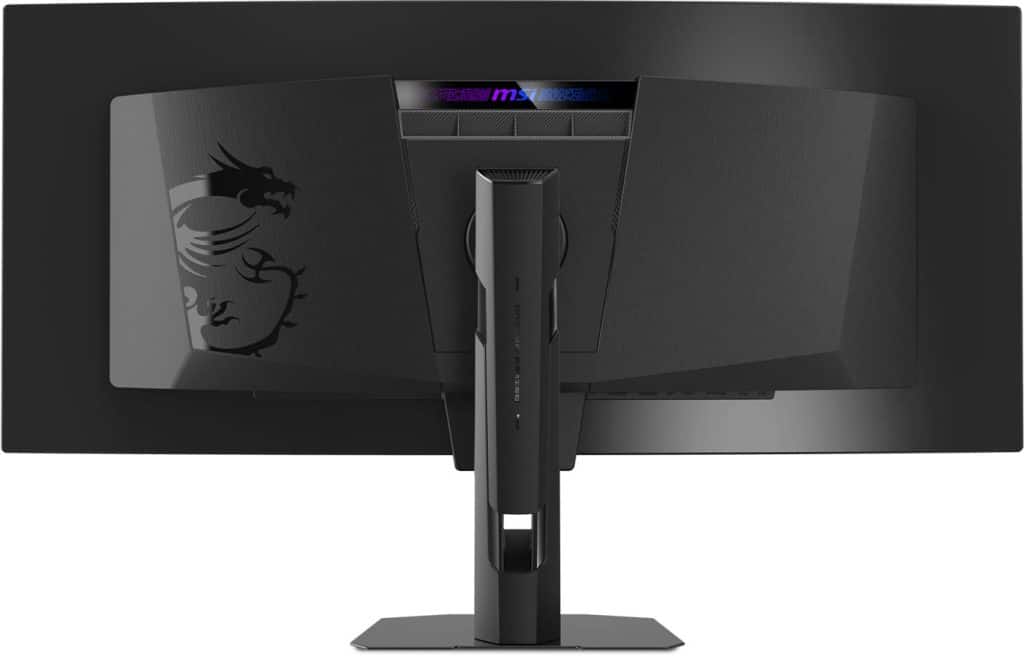
The MSI MPG 341CQR QD-OLED X36 monitor has a robust design with a fully ergonomic stand, including -5°/15° tilt, +/- 30° swivel, +/- 10° pivot, up to 110mm height adjustment and 100x100mm VESA mount compatibility.
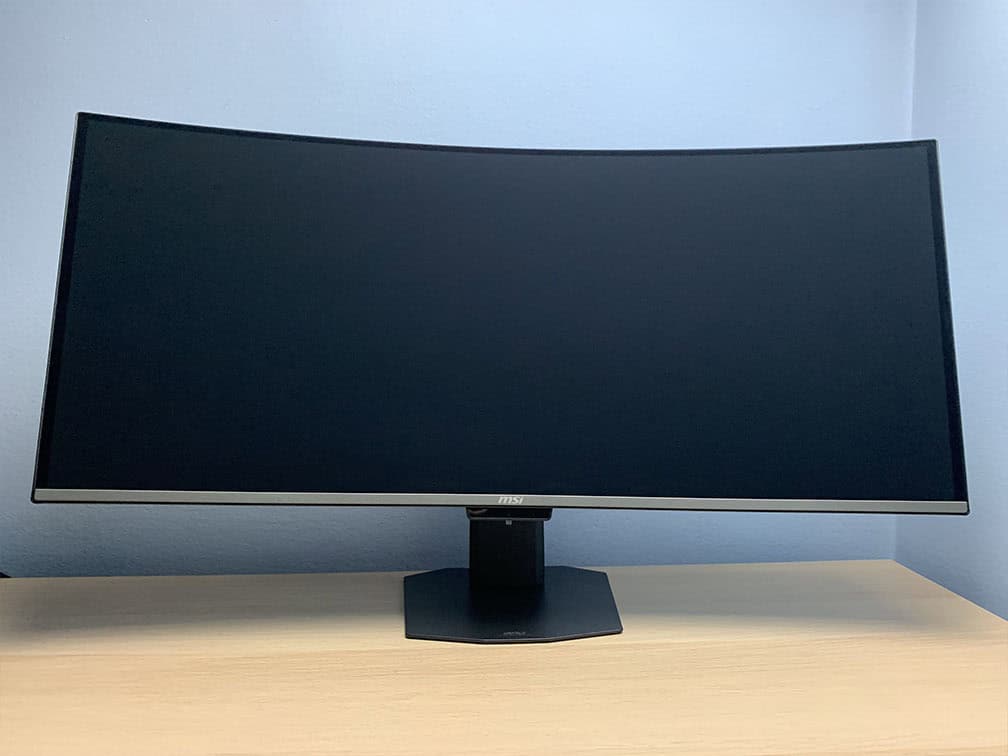
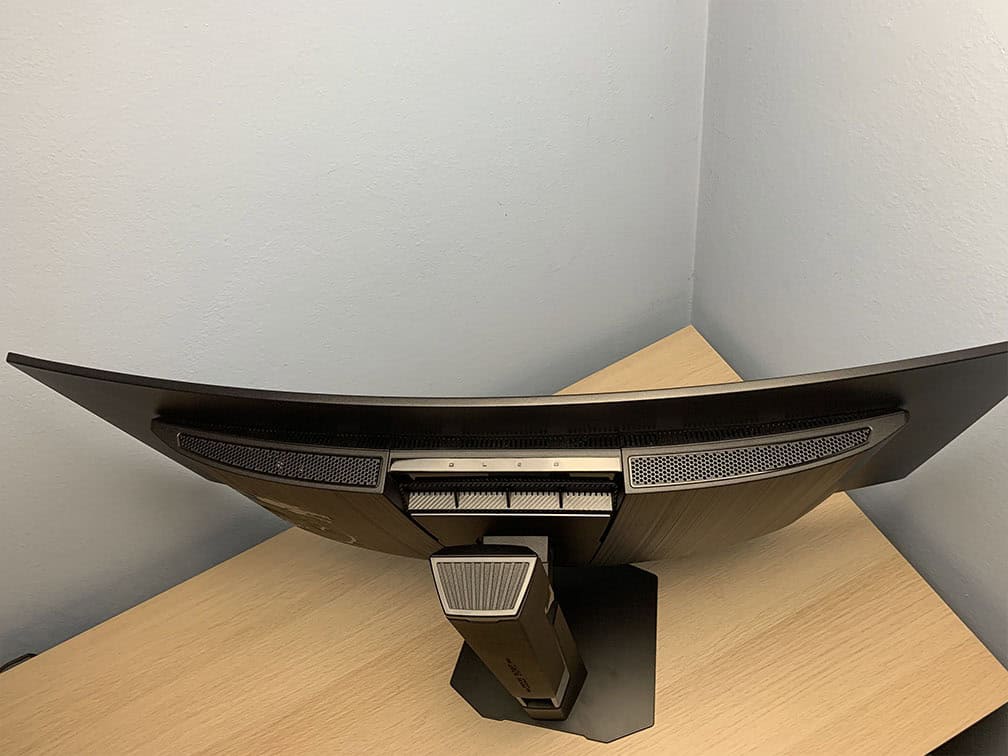
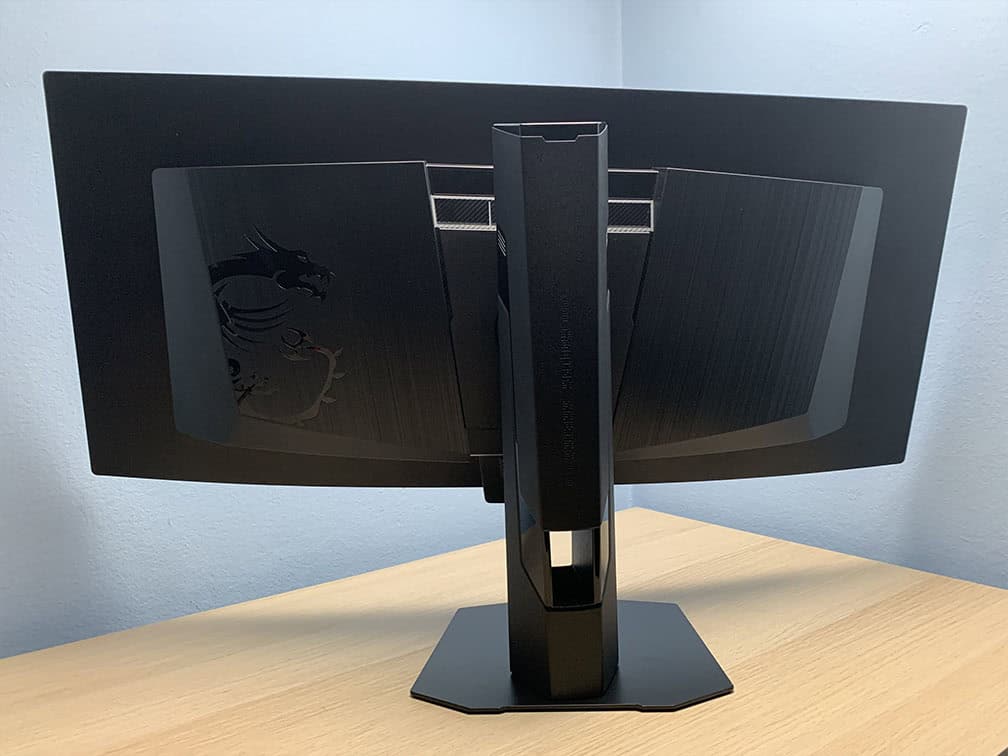
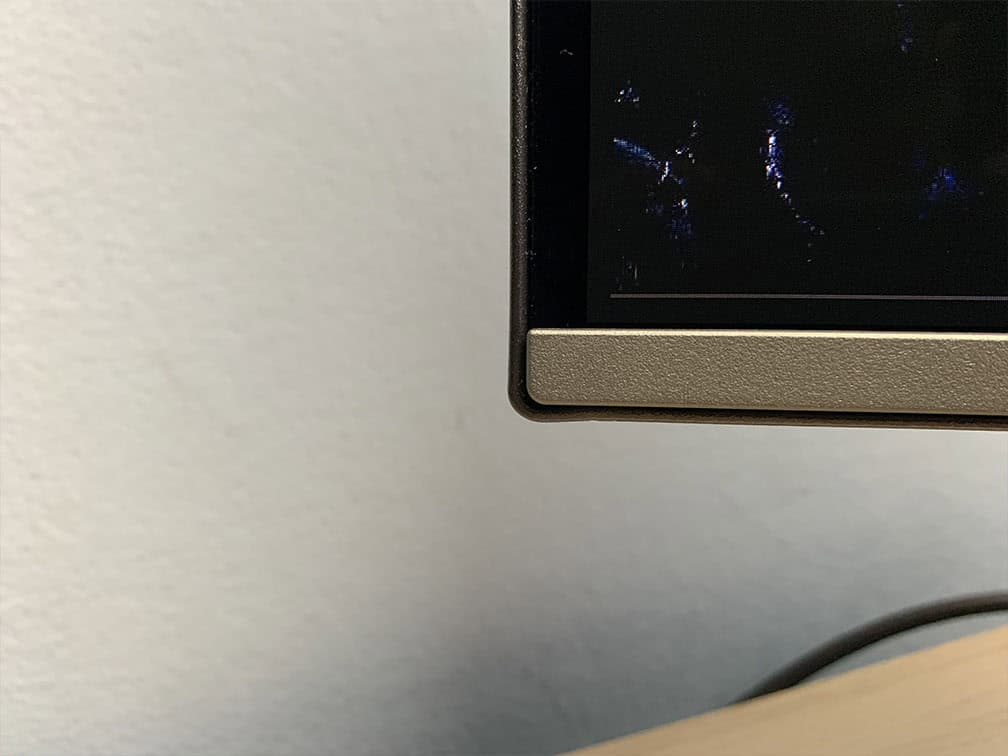
The display has ultra-thin 1mm bezels on the top and sides, while the bottom bezel is a bit thicker at 10mm with a 12mm protruding chin that houses the sensor. There are black borders before the image starts, about 7mm on the sides, 4mm at the top and 1mm at the bottom.
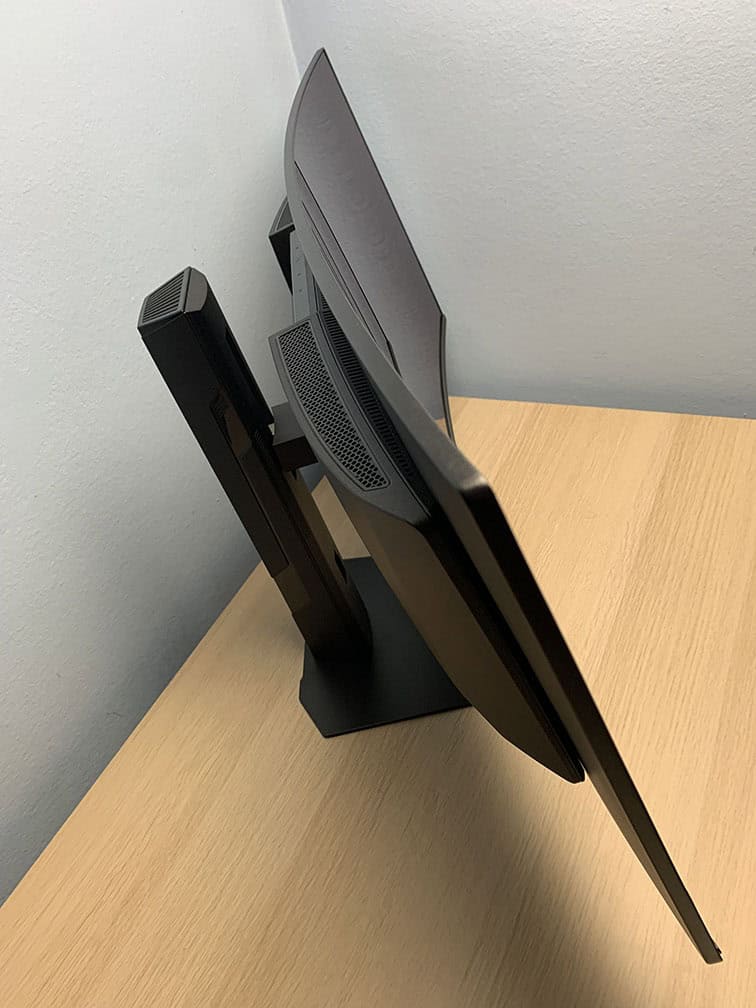
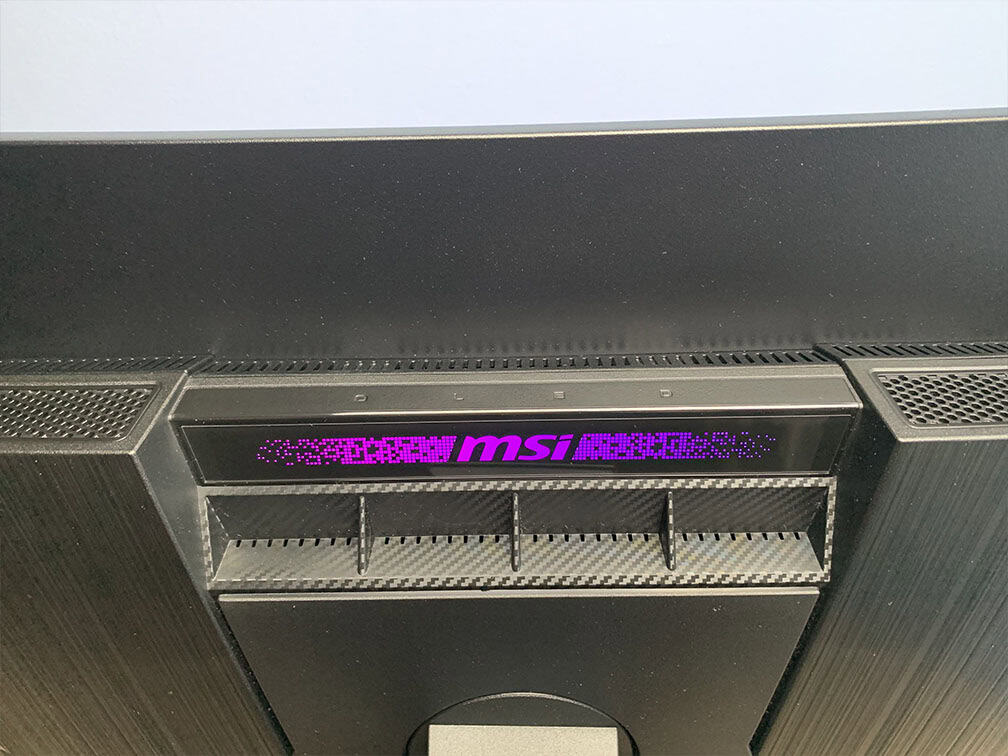
The overall design is matte and textured, with subtle glossy accents on the rear. The small strip with the MSI logo on the back also has customizable RGB lighting.
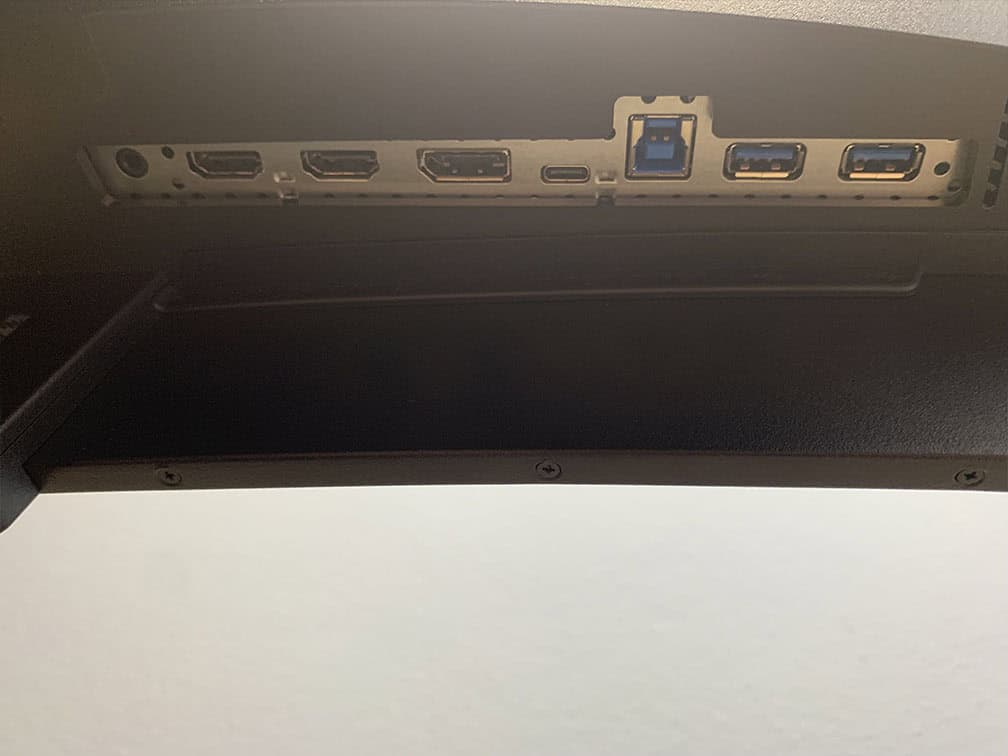
Connectivity options include two HDMI 2.1 ports with full 48 Gbps bandwidth, DisplayPort 2.1 with the UHBR13.5 transmission mode, a USB-C port with DP Alt Mode and up to 98W Power Delivery, a dual-USB 3.0 hub, KVM and a headphone jack. The screen has an integrated power supply.
DP 2.1 with UHBR13.5 still needs DSC to run 3440×1440 at 360 Hz and 10-bit color. UHBR20, on the other hand, would have enough bandwidth to do this without DSC. That said, you can already achieve 3440×1440 at 360 Hz and 10-bit on DP 1.4 GPUs as well, as long as DSC is supported.
The screen has a semi-glossy finish, which makes the image more vivid as there’s no graininess associated with matte anti-glare coatings.
MSI’s new DarkArmor Film removes the magenta tint seen in previous-generation QD-OLED panels under direct ambient light, boosts black level by 40% and improves surface hardness to 3H for 2.5x better scratch resistance.
Here’s how the MSI MPG 341CQP X36 (on the left) compares to the MSI MPG 271QR X50 (on the right) when light is aimed directly at the screen.
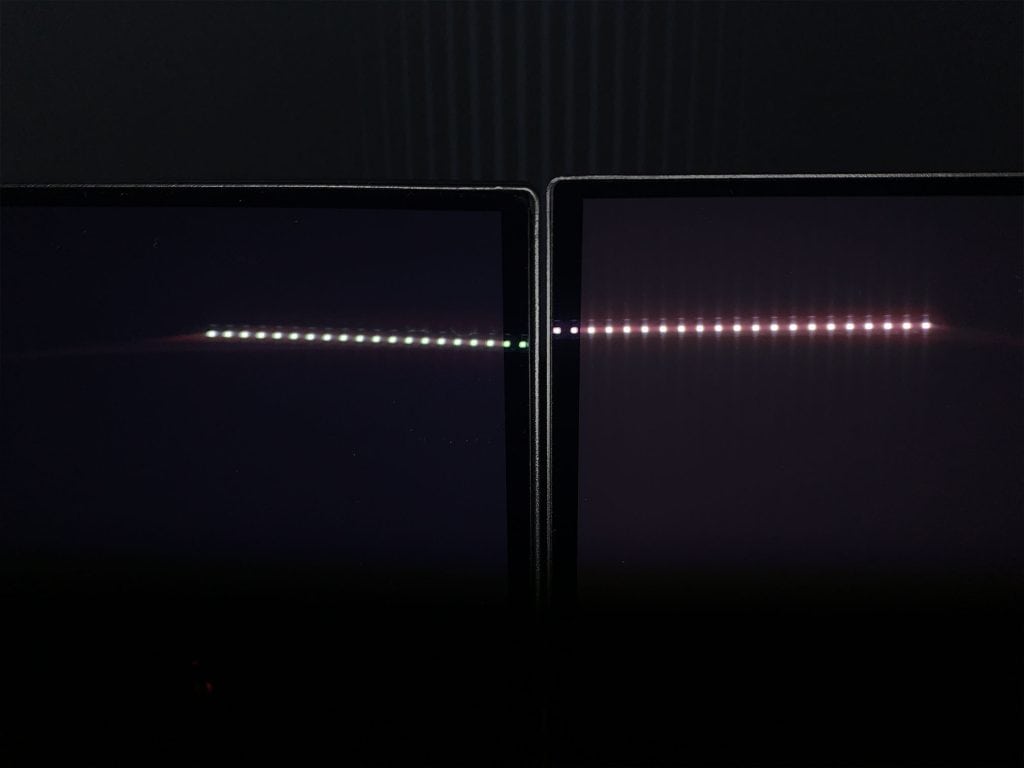
This is the same LED light bar aimed at both screens. You can see that the 271QR X50 reflects the LEDs with a purplish tint, which gives blacks that infamous magenta cast. On the 341QR X50, the reflected LEDs appear more greenish and closer to white, resulting in a more natural-looking reflection.
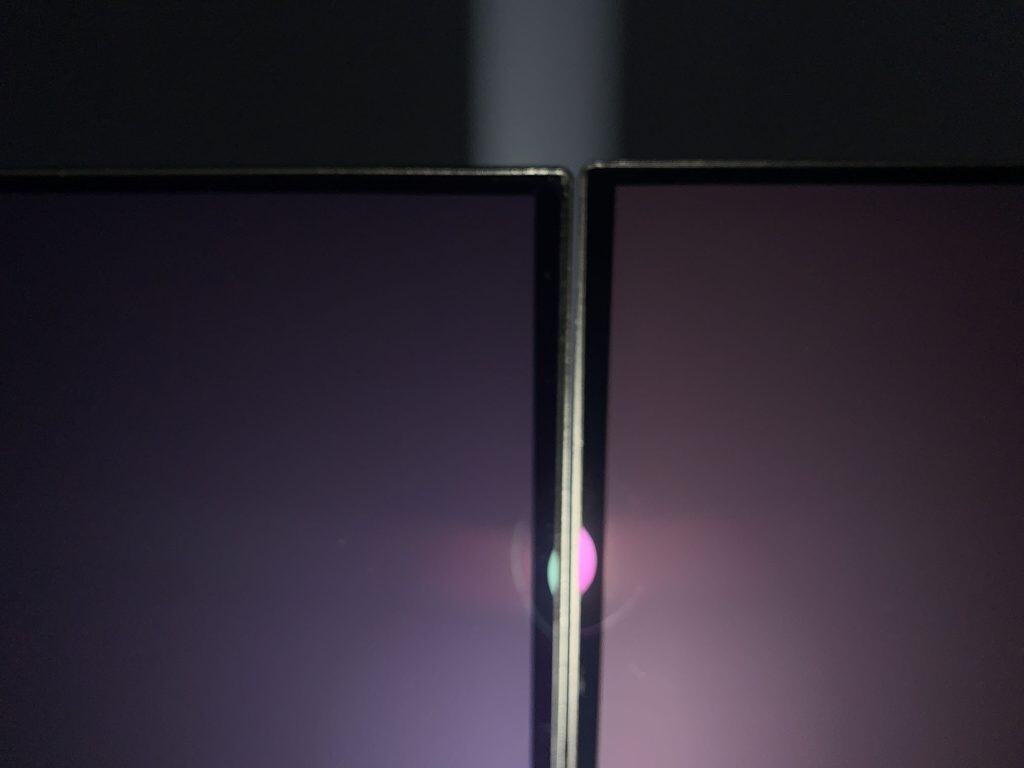
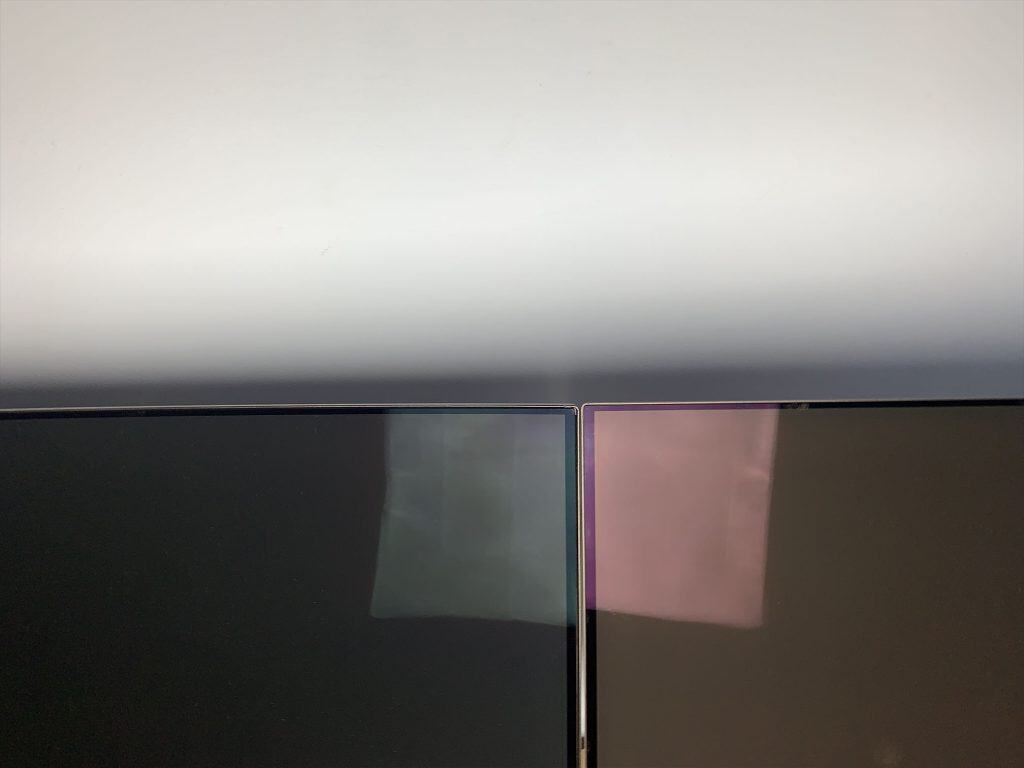
Here you can see how both screens handle an LED lamp and a softbox light aimed at the screen.
Overall, the new DarkArmor Film is a big step up from the previous-generation coating. The screen is still clearly reflective, so for the best image quality, you’ll want to avoid having any light pointed directly at it, as is the case with any glossy display.
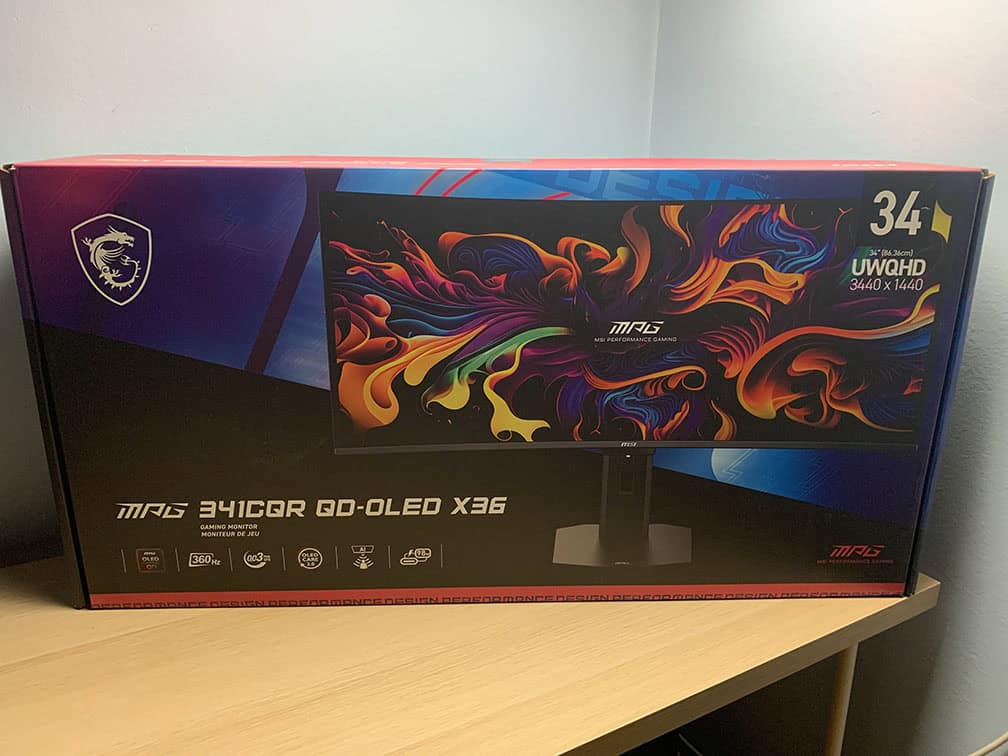
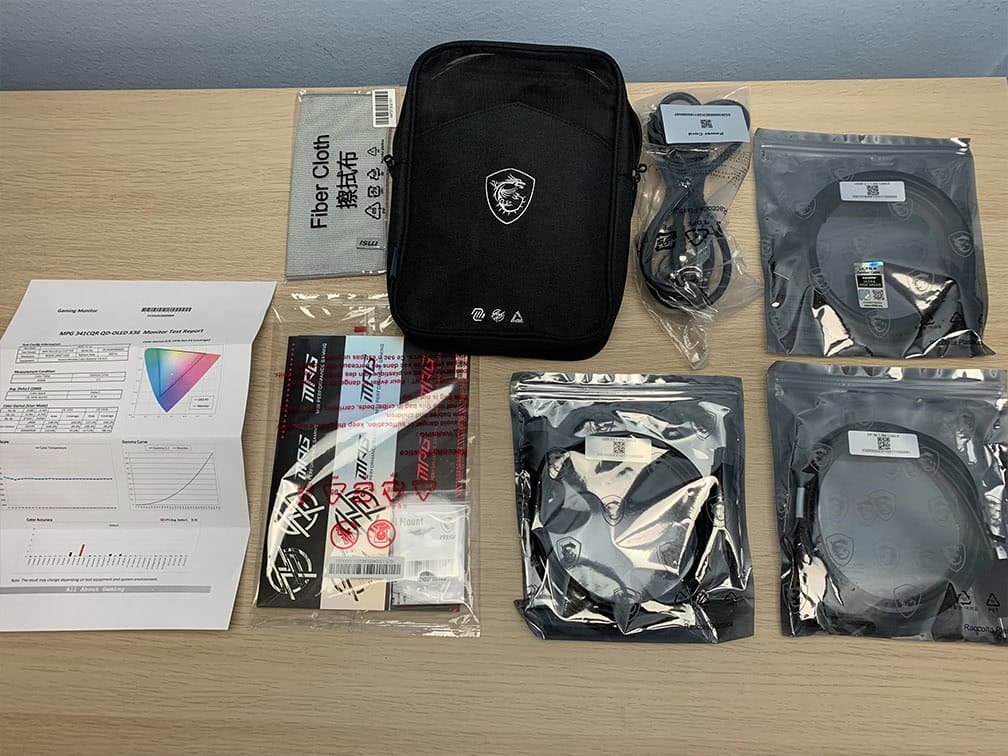
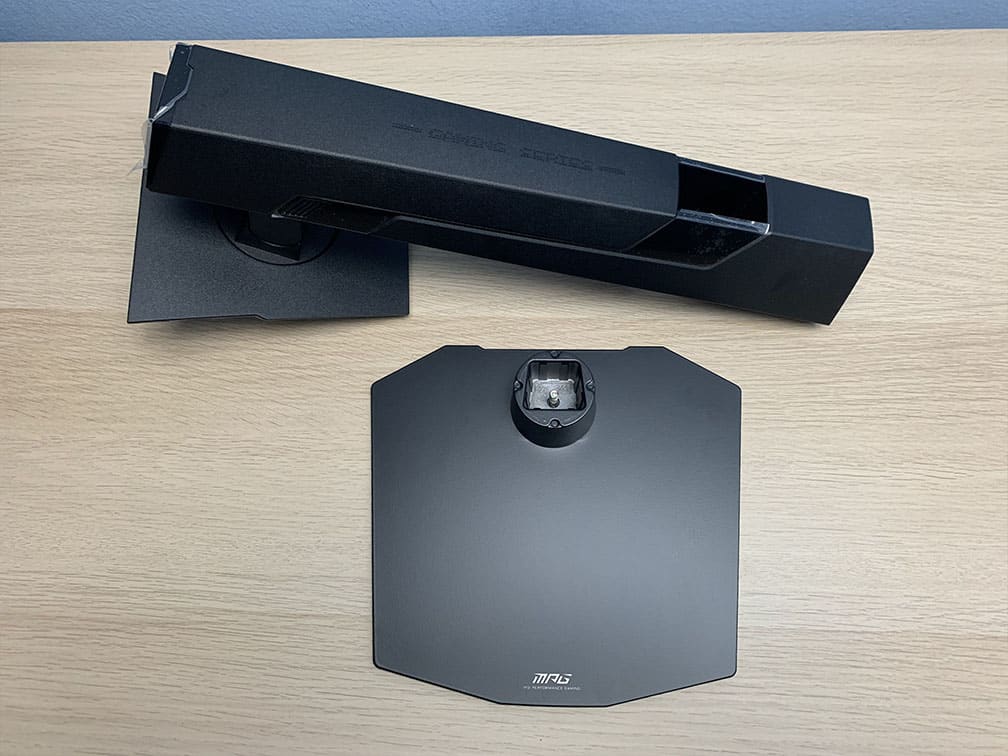
In the box, along with the monitor and its stand, you’ll get a pouch with DisplayPort 54 Gbps (UHBR13.5), HDMI 48Gbps, USB-A to USB-B 3.0 and power cord cables, a fiber cloth, a quick start guide, stickers, VESA mounting spacers and a factory calibration report.
Price & Similar Monitors
The MSI MPG 341CQR QD-OLED X36 is priced at $1,099, which is a reasonable price considering its new panel with improved brightness, text clarity and screen coating – all three of which were highly anticipated upgrades.
The release date should be in Q1 2026.
On top of that, you get an excellent design with plenty of useful features, including the AI Care Sensor, as well as extensive connectivity options, such as USB-C with 98W PD and integrated KVM functionality.
If you want something similar for less money and don’t mind a bit of minor fringing on small text and fine details, the cheaper MSI MPG 341CQPX is still worth considering at $700. It offers a 1000-nit peak brightness, True Black 400 and a 240Hz refresh rate.
For more OLED and mini LED options and details, check out our best HDR monitors buyer’s guide.
Our OLED Monitors article also keeps you up to date on the latest panels and releases, including additional 34-inch 3440×1440 360Hz models using the same QD-OLED panel, such as the ASUS PG34WCDN with full-spec DisplayPort 2.1, or the Gigabyte MO34WQC36, which is expected to cost $100 less but offers lower 18W USB-C power delivery and lacks a presence sensor.
Conclusion
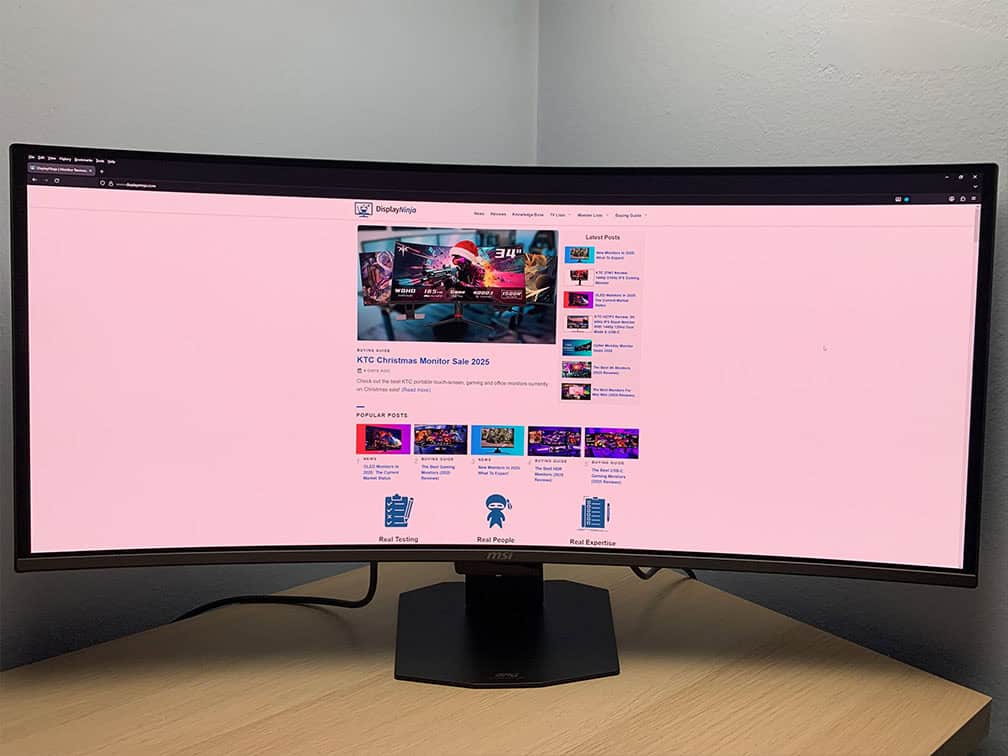
Overall, the MSI MPG 341CQR QD-OLED X36 is an exceptional gaming monitor.
The 60Hz latency was slightly higher than we’d like, while the sRGB and the EOTF Boost modes could use some tweaking. Since this is an early sample, these issues should be resolved in the final version, which we will also review once available.
Update: The FW.014 firmware update fixes the EOTF Boost performance, futher improving the monitor’s HDR image quality.
Aside from the usual OLED drawbacks (risk of burn-in, lower brightness in comparison to mini LEDs, VRR brightness fluctuation, etc.), the 341CQR X36 is one of the best ultrawide gaming monitors available.
You get a notable boost in peak brightness up to 1300-nits for punchier highlights, a new subpixel layout for sharp text without fringing, and a new coating that eliminates magenta tinting.
All these improvements are just the icing on the cake of an already excellent QD-OLED experience, with vibrant colors, inky blacks, and smooth performance thanks to instantaneous response times and a high 360Hz refresh rate.
MSI’s advanced OLED care tools, including the AI Care Sensor, make the risk of burn-in less concerning, and you get plenty of other useful features, such as built-in KVM, USB-C with 98W PD, BFI up to 180FPS, various gaming utilities, etc.
For fans of the 34″ 3440×1440 format, the MSI 341CQR X36 sets a new standard!
Specifications
| Screen Size | 34-inch |
| Resolution | 3440×1440 (UWQHD) |
| Curvature | 1800R |
| Panel Type | QD-OLED |
| Aspect Ratio | 21:9 (UltraWide) |
| Refresh Rate | 360Hz |
| Response Time | 0.03ms (GtG) |
| Motion Blur Reduction | BFI (180FPS) |
| Adaptive-Sync | FreeSync Premium (48-360Hz), HDMI 2.1 VRR |
| Ports | DisplayPort 2.1 (UHBR13.5), 2x HDMI 2.1, USB-C (DP Alt Mode, 98W PD) |
| Other Ports | Headphone Jack, 2x USB-A 3.0, USB-B |
| Brightness (1 – 3% White Window) | 1300 cd/m² |
| Brightness (10% White Window) | 500 cd/m² |
| Brightness (100% White Window) | 300 cd/m² |
| Contrast Ratio | Infinite |
| Colors | 1.07 billion (true 10-bit) 99.3% DCI-P3 |
| HDR | VESA DisplayHDR True Black 500, TrueBright 500 |
| VESA | Yes (100x100mm) |
The Pros:
- Instantaneous pixel response time, low input lag, VRR up to 360Hz, BFI up to 180FPS
- Infinite contrast ratio, exceptional color gamut, accurate sRGB mode
- Brightness and text clarity improvements over previous-gen panels
- Plenty of useful features, including AI Care Sensor and DarkArmor Film
- Fully ergonomic design and rich connectivity options, including USB-C 98W PD and KVM
- 3-year warranty that covers burn-in
The Cons:
- Risk of burn-in
- Glossy screen surface causes mirror-like reflections (but makes the image more vivid)
- VRR brightness flickering in some games (expected on OLED and VA panels)